
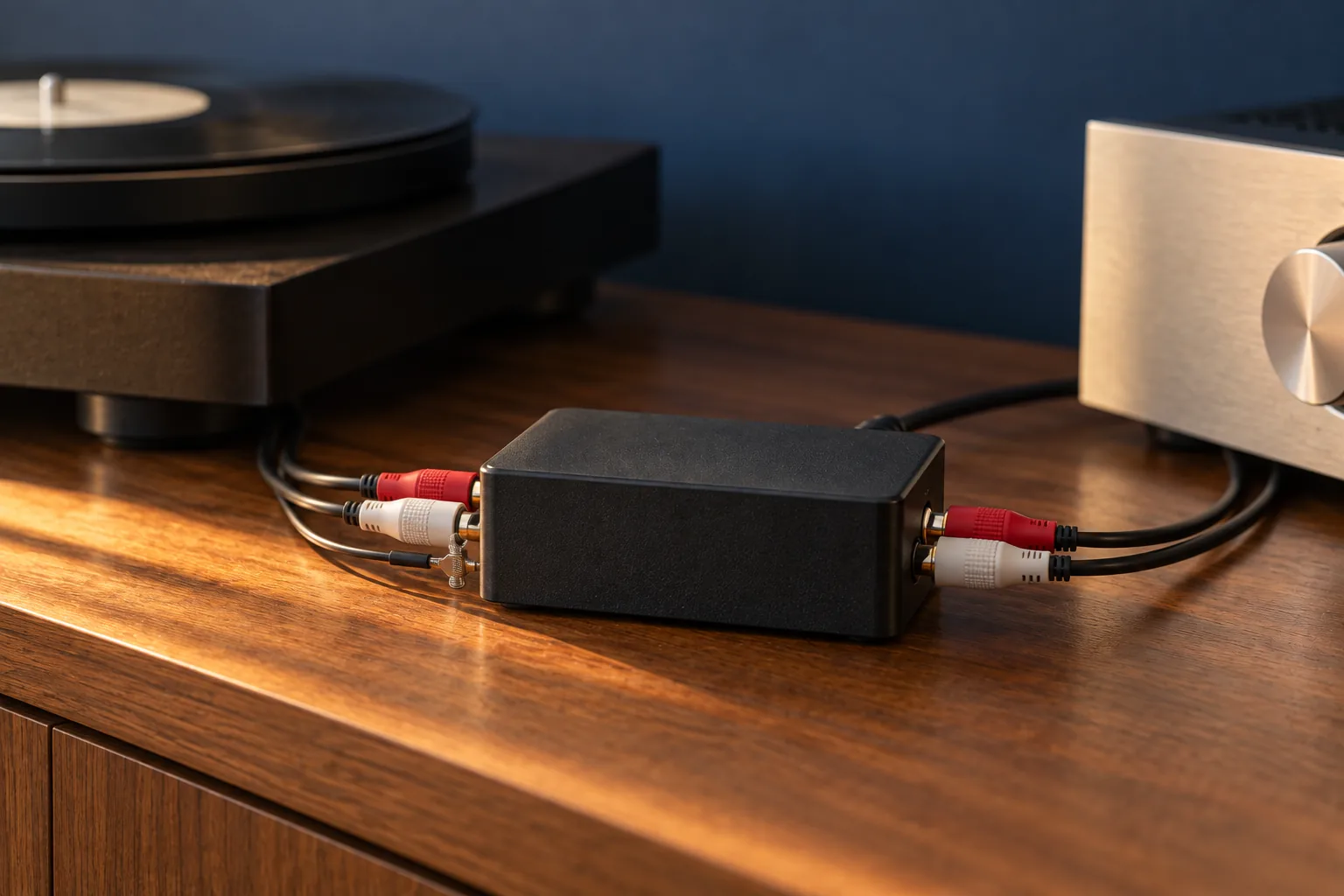
The problem: You read that a turntable needs a phono preamp, but you do not know whether you already have one, or whether a separate box adds something or spoils it.
The short route: Check the turntable and the amplifier first. If there is one already, buy nothing. If it is missing, a simple box is enough for an MM cartridge.
Do you need a phono preamp? Often you already have one
Anyone who looks up whether they need a phono preamp is usually offered a box first. Better to start with the question itself, because the answer is often no. A turntable needs exactly one phono preamp, and in many setups it is already there: in the turntable itself, in the amplifier or in the active speakers. Then you need to buy nothing, and adding a second box makes the sound worse rather than better.
You already have one, and so need to buy nothing, if your turntable has a switch marked phono and line, if your amplifier has an input labelled phono, or if your active speakers have a phono input. You do need one if none of those three is true: a turntable without a built-in preamp, on an amplifier or speakers with only line, aux or CD inputs. That is the case, for example, with many old turntables from the market, and with a new turntable on a modern amplifier without a phono input.
This guide works through that question first, because it is the cheapest step: looking costs nothing. After that it covers what a separate box actually does, the difference between an MM and an MC cartridge, and what such a box should cost. How to connect the whole chain from turntable to speaker is covered in the guide on connecting your turntable.
Where to look: turntable, amplifier and speakers
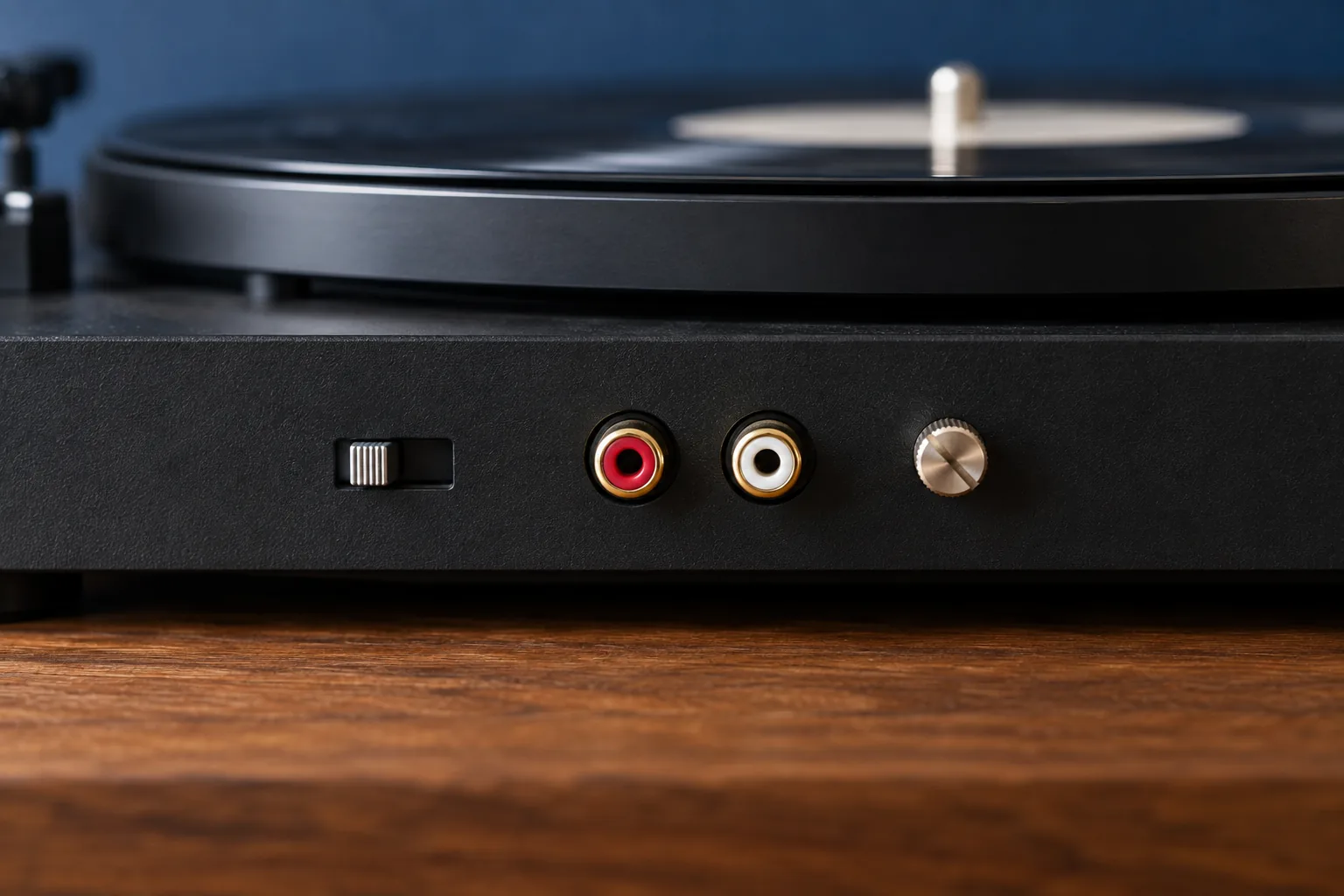
Start at the back of the turntable. If you see a small slide switch with two positions next to the two RCA outputs, the red and the white, the turntable has a built-in preamp you can switch on and off. On most turntables the positions are labelled: phono or off means the signal goes out unprocessed, line or on means the built-in preamp has already done the work. Almost every new entry-level turntable has such a switch. If there is no switch and nothing in the manual about a built-in preamp, the turntable puts out a phono signal.
Then look at the back of the amplifier or receiver. An input labelled phono, almost always with a small screw for the earth wire next to it, is a built-in phono preamp. Older amplifiers and receivers nearly all have one, because the turntable was the main source then. With newer amplifiers it varies by model, and soundbars and TV receivers rarely have one. All the other inputs, line, aux, CD, tuner and tape, are line inputs and do not do the work of a phono preamp.
If you use active speakers, look at the connection panel on the speaker where the cables go in. Some sets have an input called phono, or a switch by the input marked phono and line. If it only says line or aux, the preamplification has to happen earlier in the chain: in the turntable or in a separate box.
If in doubt, look up the model number of the turntable or the amplifier and read in the manual or specifications whether there is a phono input or built-in phono preamp. That information is almost always there, and it saves you a purchase you did not need.
Two in a row: the mistake made most often
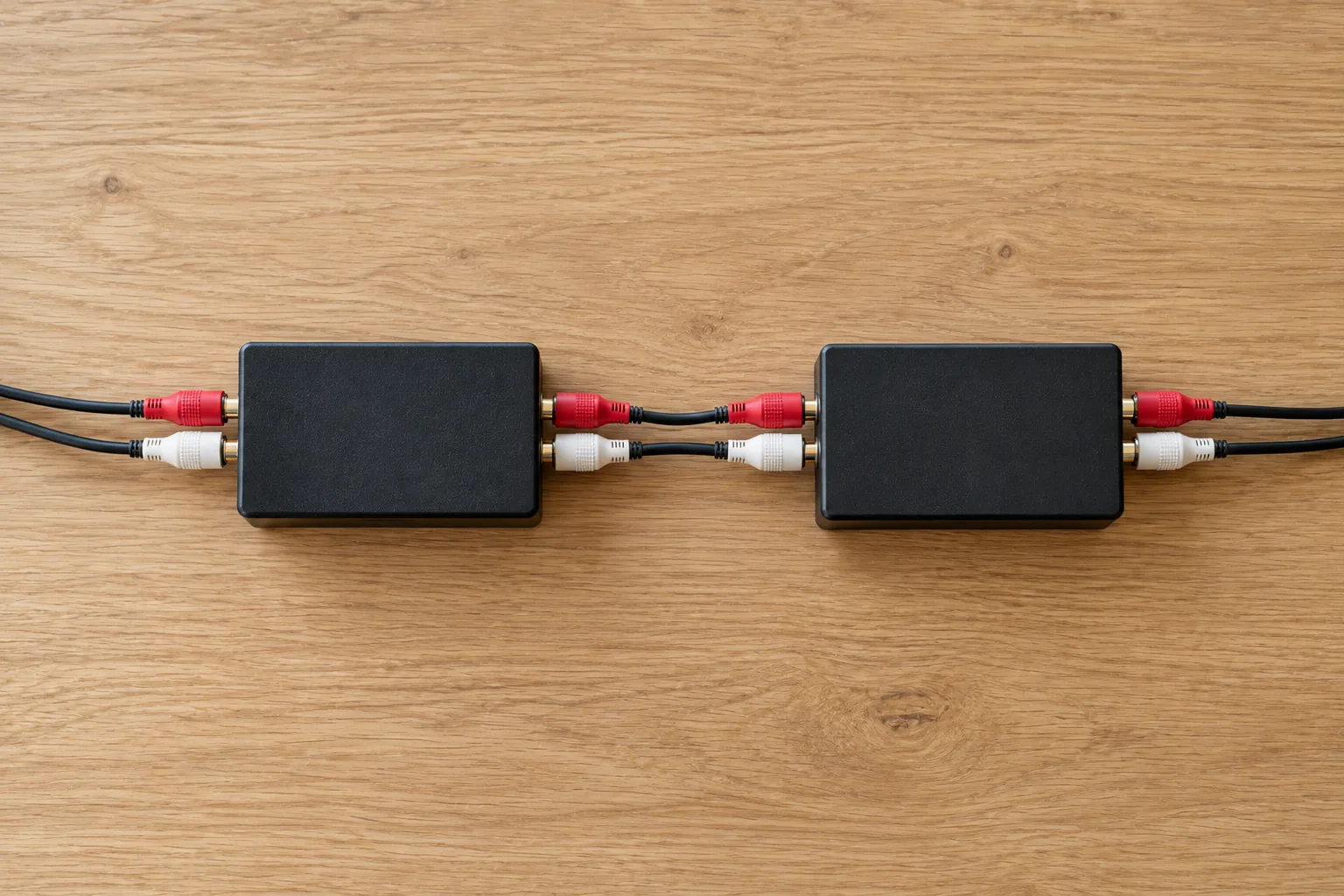
The most common mistake is not a missing preamp, but one too many. Someone buys a turntable with a built-in preamp, connects it to the phono input of an old amplifier, or puts a separate box in between because that is what you do with turntables. Then the signal is amplified twice and corrected twice. The result is loud, distorted sound even at low volume, with a sharp, harsh top end and bass that sounds messy.
The fix costs nothing. If the turntable has a switch, set it to phono or off as soon as you connect it to a phono input or a separate box, or leave the switch on and choose a line input on the amplifier. A separate box you had already bought for it is then unnecessary. So keep the receipt until you have checked what is already in your setup.
The opposite mistake gives the opposite sound. With no phono preamplification at all, a very quiet, thin signal comes out of the speakers, with almost no bass, and you have to turn the volume right up to hear anything. Many people then think the turntable or the speakers are broken, when only one link in the chain is missing. What to do if it also hums is covered in the guide on connecting your turntable.
What a phono preamp actually does
A phono preamp does two things at once. The first is amplification. The cartridge in the tonearm puts out a very small signal, a few thousandths of a volt with a common MM cartridge. A line input expects a signal about a hundred times stronger. That is why a turntable on a line input without preamplification sounds so quiet.
The second is correction, and that is why you cannot solve the problem by turning the volume up further. When a record is cut, the bass is turned down and the treble turned up, following a fixed standard called RIAA. Quieter bass makes the groove narrower, so more music fits on a side, and louder treble keeps the record's surface noise below the music. The phono preamp reverses that exactly: it turns the bass back up and the treble back down. Without that correction a record sounds thin and shrill, however loud you play it.
That is also why the phono input of an amplifier is not an ordinary input with an extra volume setting. It does both of those steps, just like a built-in preamp in the turntable or a separate box. Where it happens makes no difference to the principle, as long as it happens once.
MM or MC: check which cartridge you have first
Which box suits you depends on the cartridge in your tonearm. There are two main kinds. An MM cartridge, moving magnet, is what sits on almost every entry-level turntable and most mid-range ones. It puts out the signal every phono input and every simple box is built for, and its stylus can almost always be replaced on its own. How to do that is covered in the guide on replacing the stylus.
An MC cartridge, moving coil, puts out an even smaller signal, on most models about ten times weaker than an MM cartridge. A phono input built for MM amplifies that too little: it sounds quiet and noisy. For such a cartridge you need a preamp with an MC setting, or a box made specially for MC. MC cartridges sit mainly on more expensive turntables, and the stylus usually cannot be replaced on its own; when it wears, the whole cartridge goes back to the maker or the shop.
There is an in-between kind, the high-output MC cartridge, which puts out a signal strong enough for an ordinary MM input. If you do not know what is on your turntable, look up the name on the cartridge. If the cartridge is not in your turntable's description, on an entry-level turntable and almost every old turntable from the market it is an MM cartridge. Anyone buying a used turntable should count on this: almost no turntable from the seventies or eighties has a built-in preamp, because every amplifier then had a phono input.
What should a phono preamp cost?
For an MM cartridge a simple box is enough. It only has to do the amplification and the correction well, and that is no feat: the technology is decades old and well understood. Separate boxes for MM start at around thirty euros, and boxes from established hi-fi brands sit roughly between fifty and a hundred euros. In that class you get a sturdy case, an earth screw and a separate power adapter, and that is what you need.
What more expensive boxes add is mainly flexibility: an MC setting, adjustable loading for different cartridges, a filter against the low rumble of warped records, or a headphone output. That last one can be handy if you want to listen without an amplifier; more on that in the guide on headphones for your turntable. If you have an MC cartridge, an MC setting is no luxury and starts at about a hundred to a hundred and fifty euros. If you have an MM cartridge and no plans to change, you are paying for options you will not use.
A good rule of thumb is that the box should not cost more than the cartridge in your arm. An expensive box behind a forty-euro cartridge gets nothing out of it that is not there. If you want to improve the setup, with an entry-level turntable there is often more to gain from a better cartridge or a better spot for the turntable than from the preamp.
Some boxes have a digital or USB output, so you can connect them to a computer to record records. That is a reason to buy one if you really want to do that, not because it happens to be included.
A separate box instead of the built-in preamp
A turntable with a built-in preamp can always do without it: set the switch to phono or off and connect it to a separate box or a phono input. That is why the guide on buying a turntable recommends such a switch. You can later buy an amplifier with a phono input without the built-in preamp getting in the way.
Whether a separate box sounds better than your turntable's built-in preamp depends on both. The preamp in a cheap turntable is built to fit that turntable's budget, and sits right next to a motor and a power supply. A separate box does not have those limits. The difference can be audible, especially in noise and in how tight the bass sounds, but it is rarely big. If your setup works and you are happy, this is not the first place to spend money.
The same goes for the phono input of a good amplifier. It is often fine, and putting a separate box in front of it only makes sense if you have a cartridge that input does not support, such as an MC, or if the input hisses or hums while the earth wire is properly attached.
Connecting it and where to put it
A separate box goes between the turntable and a line input on the amplifier or the active speakers. The turntable's RCA cable goes into the box's input, and a second RCA cable runs from the box's output to line, aux or CD on the amplifier. Red is right, white is left. Screw the turntable's earth wire to the screw on the box, not to the amplifier. And the switch on the turntable, if there is one, is set to phono or off.
Put the box close to the turntable, so the thin cable carrying the weak signal stays short, and as far as possible from power cables, power strips and the amplifier's power supply. The weak signal between cartridge and preamp picks up hum more easily than any other stretch of cable in the setup. Preferably plug the box's adapter into the same power strip as the amplifier.
You usually need a second RCA cable, because far from every box comes with one. An ordinary, short cable is enough; you will not hear expensive cable at this distance, and the difference is in a sturdy plug that grips the socket well. Then turn the volume down, start a record and turn it up gently. If it sounds full and undistorted at a normal volume setting, there is exactly one preamp in the chain, and you are done.
Frequently asked questions
- Do I need a phono preamp?
- Only if there is not one in your setup already. If your turntable has a switch marked phono and line, or your amplifier or active speakers have an input labelled phono, you already have one. If you have none of those three, you need a separate box between the turntable and a line input.
- What happens if you use two phono preamps?
- Then the signal is amplified twice and corrected twice, and it sounds loud and distorted even at low volume. Set the switch on the turntable to phono or off if you connect it to a phono input or a separate box, or choose a line input on the amplifier.
- What does a good phono preamp cost?
- For an MM cartridge, which sits on almost every entry-level turntable, separate boxes start at around thirty euros and those from established hi-fi brands sit roughly between fifty and a hundred euros. For an MC cartridge you need a box with an MC setting, and that starts at around a hundred to a hundred and fifty euros.
- Can you connect a turntable without a preamp to an aux input?
- It works, but it sounds very quiet and thin, without bass, because the signal is neither amplified nor corrected. On an aux or line input the preamplification has to happen earlier: with the turntable's built-in preamp switched on, or with a separate box in between.