
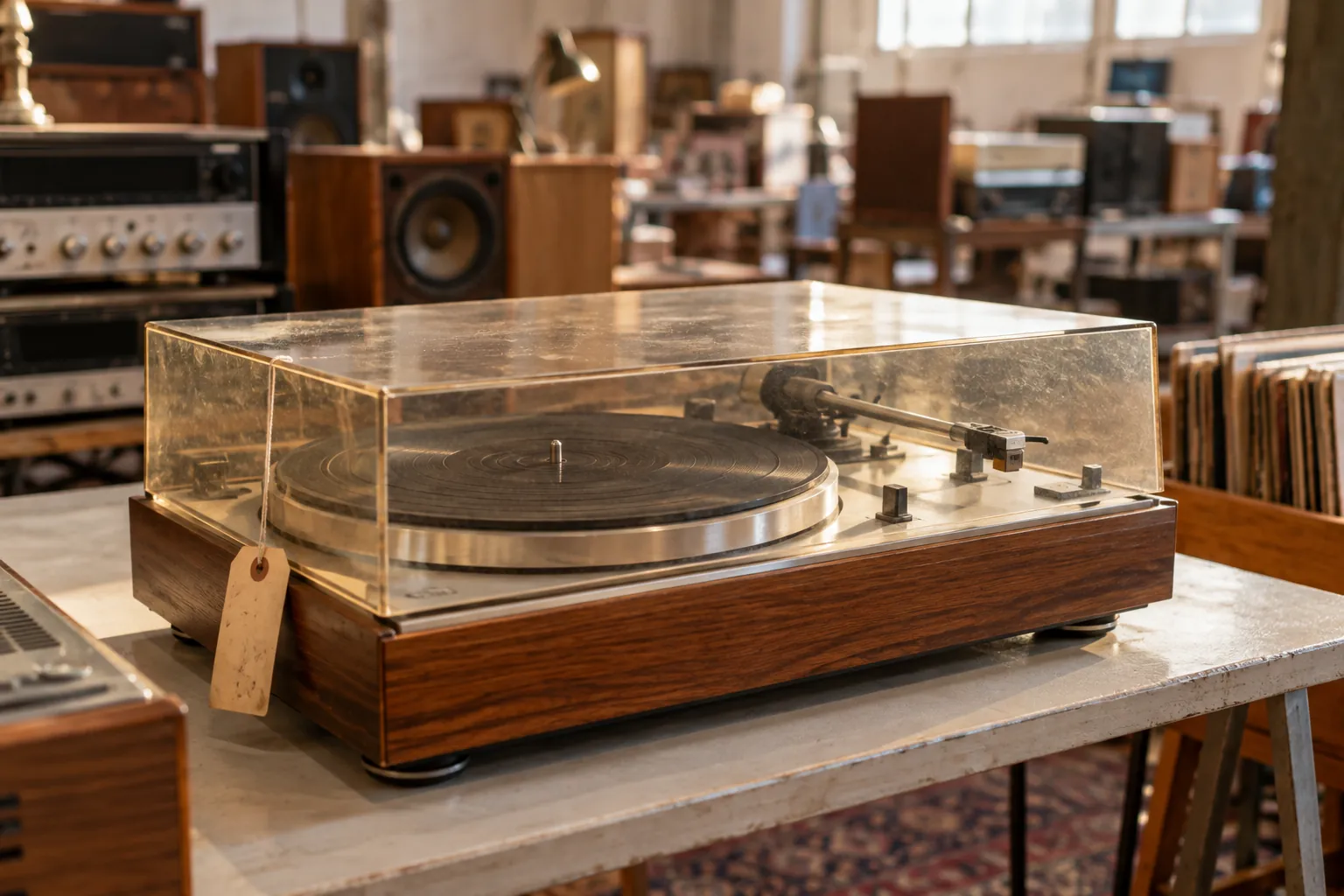
The problem: You see an old turntable going cheap, but you do not know whether it is a bargain or a box of parts.
The short route: Check the arm and the bearing first, budget for a new stylus and belt, and walk away if there is play.
Why buying a used turntable often pays off
Anyone who wants to buy a used turntable has a good argument. Turntables from the seventies and eighties were built when the turntable was the centrepiece of the living room, with heavy platters, metal arms and motors designed to run for decades. For the price of a new entry-level turntable, there is often one on a marketplace or at a fair that was sold a class higher in its day.
The difference lies in what has happened to such a turntable in forty years. Rubber hardens, grease dries, a stylus wears and an arm may have been dropped once. Some of those things can be fixed in a quarter of an hour for a few tens of euros. Others make the turntable worthless, however good it looks. This guide is about the difference between the two, and about what to check on the spot before you pay.
The sums come later, but the conclusion can come now: an old turntable with a good arm and a new cartridge is often better than a new turntable in the same price range. If you have no wish to check and set things up, you are better off buying new. What to look for in a new turntable is covered in the guide on buying a turntable.
Before you go and look
Ask the seller for the make and model, and look up two things before you leave the house: is there a replacement stylus for the cartridge fitted, and is a belt in the right size for sale? For the well-known brands of that era the answer is usually yes, and then you know straight away what the turntable will cost you on top of the asking price. If the answer is no, that is no reason to give up, but it is a reason to talk about the price.
Also ask whether you can hear it play, and take along a record you know well that is in good condition. A record of the seller's says little: if it clicks or distorts, you do not know whether it is the record or the turntable. A phone with a torch helps to look at the stylus, and a speed app on the same phone shows whether the platter is turning at the right speed.
Notice what is not in the listing. 'Untested' or 'working unknown' means it does not work or the seller does not know, and either way you are paying for a parts turntable. 'Stylus needs replacing' is actually an honest line: you would have wanted to replace that stylus anyway.
What to look at first: the tonearm
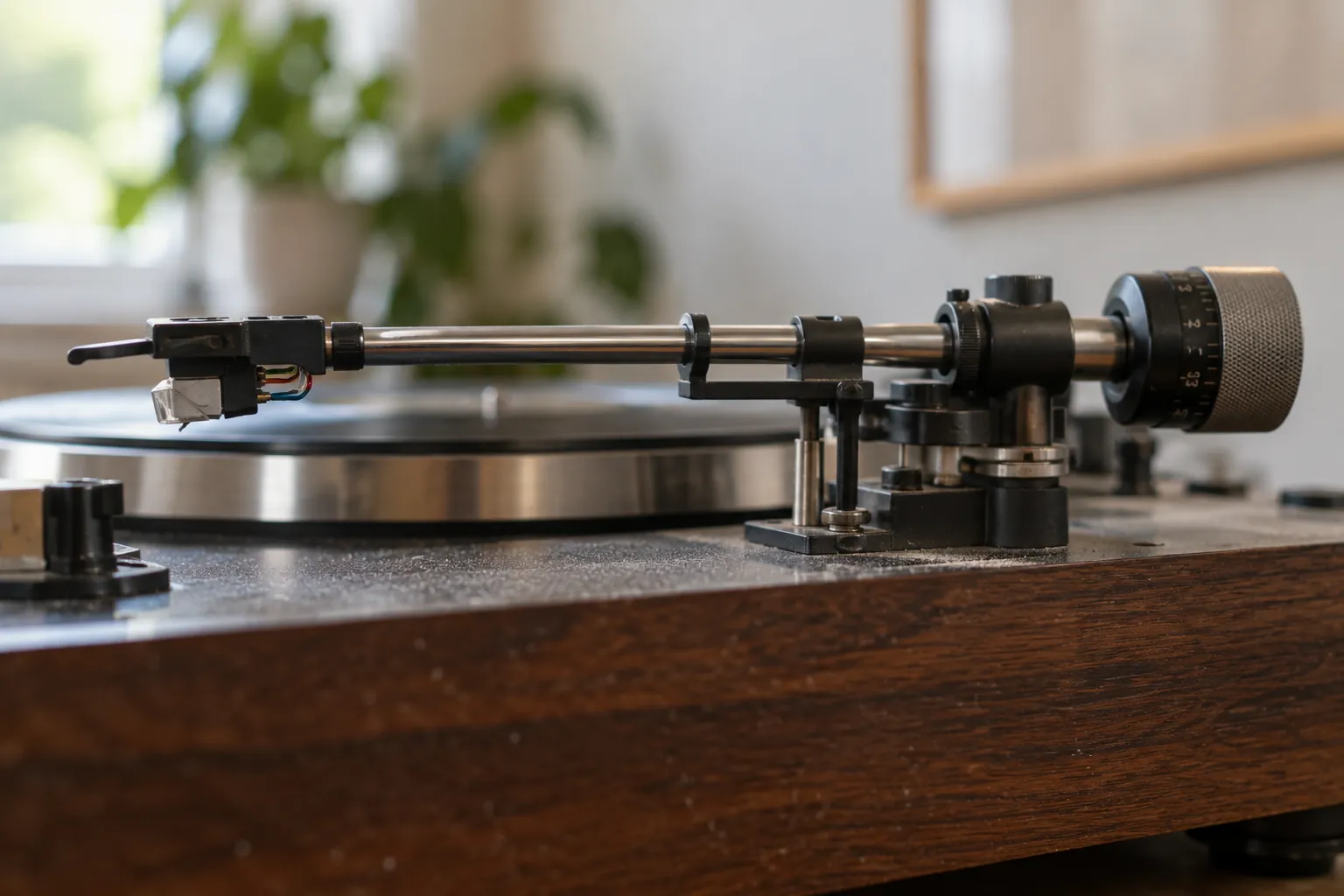
Start with the arm, because it is the part that decides the most and is the hardest to replace. Lift it out of its rest and, holding it near the base with two fingers, move it slowly left and right and up and down. It should move smoothly and evenly, with no catches and no point where it sticks. Then feel for play: hold the base of the arm and very gently wiggle the arm tube. An arm that ticks or rattles in its bearing is a reason to walk away. That bearing cannot be replaced separately on most turntables, and an arm with play makes the stylus wander in the groove.
Next, look along the arm tube to see whether it is straight, and check that the counterweight at the back still turns and the scale is readable. You set the tracking force with that weight; if it is stuck or missing, the turntable cannot be set up properly. Check the lift too, the little lever that lowers the arm. The arm should descend slowly. If it drops like a stone, the damping has dried out. That can be fixed, but until then you drop the stylus onto the record every side.
A detachable headshell, the small head at the front held on to the arm with a screw collar, is standard on many older turntables and an advantage. You can fit any common cartridge to it, and you change it at the table instead of above the platter. Do check that the four thin wires to the cartridge are intact and not turned green.
The cartridge and the stylus
With a used turntable, budget for a new stylus, whatever the seller says. You do not know how many hours it has played, on which records and with what tracking force, and as the guide on replacing the stylus explains, the suspension hardens even when a turntable stands unused for years. A replacement stylus for a common MM cartridge costs between twenty-five and sixty euros. Add that to the price and you will not get a surprise at home.
What you do check on the spot is whether the stylus is still there and whether it is damaged. Shine the phone torch on the tip from the side. The thin tube the diamond sits on, the cantilever, should hang straight down and in the middle. A crooked or flattened cantilever means the stylus must not go on a record, not even 'just to try', because a damaged tip ruins the record you brought along.
If the replacement stylus for the old cartridge is no longer available, or there is a cartridge on it whose model nobody knows, a new cartridge is often the better route. Almost all headshells have the standard two-screw mounting, and any common MM cartridge fits it. A modern cartridge costs from about eighty euros, and on a good old arm that is the cheapest upgrade there is: you get the build quality of then with a cartridge of now.
Lift the platter off
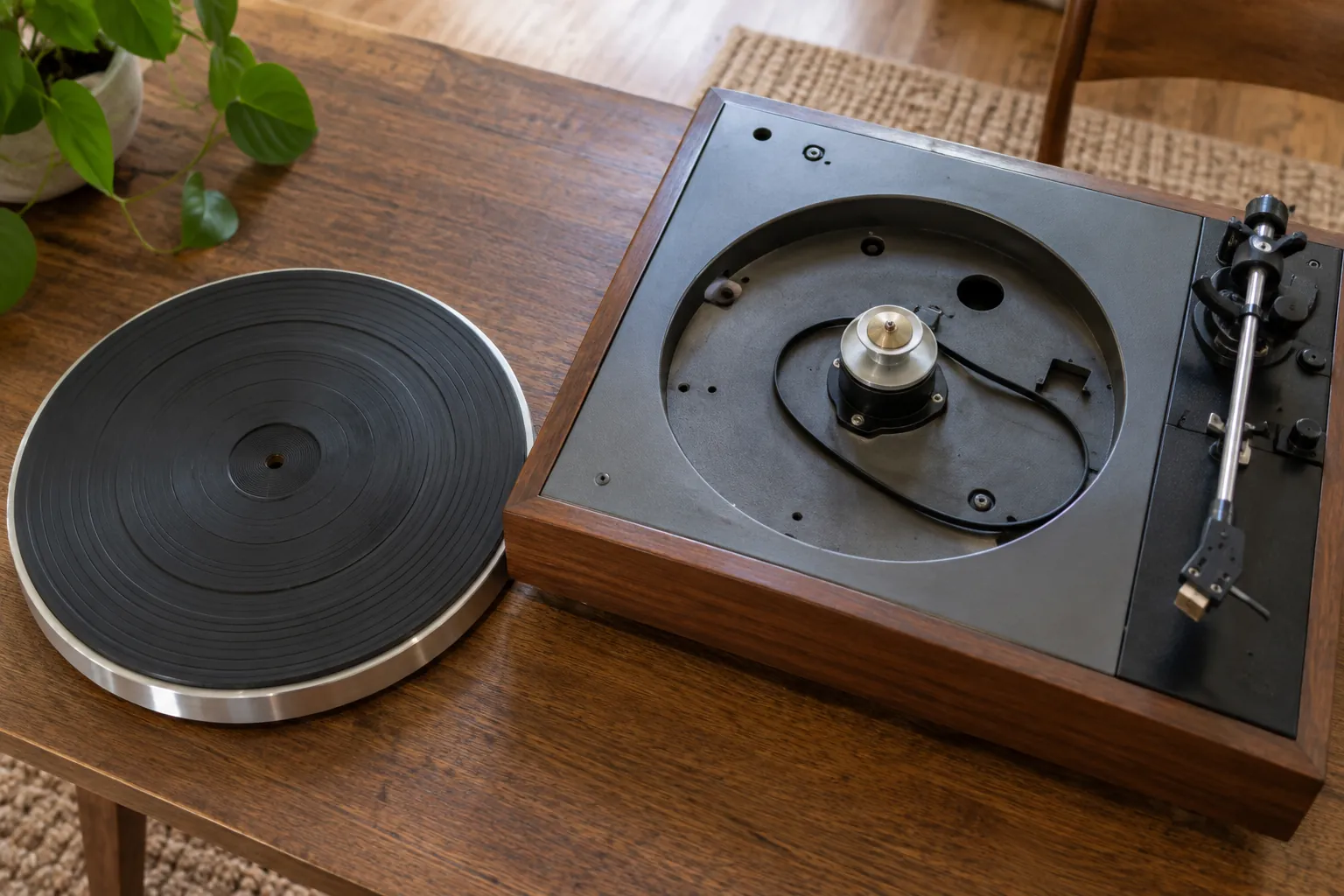
Ask whether you can take the platter off. On most belt-driven turntables it sits loose on the spindle: take off the rubber mat and lift the platter straight up. What is underneath tells you more than the whole outside.
Look at the belt first. It should sit tight around the motor pulley and the inner platter, black and matt. A belt that hangs slack, shines, sticks or has little cracks is finished. That is no problem: a new belt costs a few tens of euros and goes on in a minute. If the belt is missing altogether, even the seller does not know whether the motor works, and that is a problem.
Then turn the inner platter by hand and push it gently from side to side. The main bearing should turn without grinding, rattling or sideways movement. Play or a grinding noise is the end of the turntable: repairing a bearing is a job for a specialist and soon costs more than the turntable is worth. A dry bearing with no play just needs a drop of the oil the manufacturer specifies.
On a direct-drive turntable there is no belt and the motor sits under the platter. There you mainly check that it gets up to speed in one go and holds it. Older turntables with an idler wheel, a small rubber wheel that drives the platter, have the same weak point as a belt: the rubber goes hard, gets a flat spot, and then you hear a low rumble. For some models a new wheel is easy to get and for others not, so look it up before you pay.
Let it play
Put your own record on and listen for three things. First the speed: lay the phone with the speed app on the platter, or look at the strobe dots on the rim, which on many older turntables appear to stand still under the little lamp when the speed is right. A turntable that runs just too slow often has a stretched belt. A turntable where long notes start to waver has a belt, idler or motor that is not right. A new belt usually solves the first; not always the second.
Then the sound. Listen whether both channels play equally loud, and whether there is hum: a low buzz that stays when the stylus is in the run-out groove. Hum usually comes from an earth wire that is not connected, and then it is not the turntable's fault, but try it on the spot. A channel that drops out or crackles as soon as you move the cable points to a loose connection. A loose RCA cable is quickly replaced; a fixed cable that has to be replaced from the inside is a soldering job.
If the turntable has an automatic mechanism that puts the arm on the record itself or returns it at the end of the side, try it a few times. Dried grease makes such a mechanism falter or stop halfway. Cleaning and re-greasing often helps, but it is not a job for everyone, and separate parts for such a mechanism are no longer available for many models.
If the seller cannot let you hear it because there is no amplifier, ask whether it can at least be switched on. If the platter turns, gets up to speed and the lift works, you have seen the most important things. If you hear something you do not trust, that is no reason with a used turntable to give the seller the benefit of the doubt.
What is cheap, and what you walk away from
Cheap to fix: a worn stylus, a stretched belt, an unknown cartridge you replace with a new one, a dry bearing with no play, a loose RCA cable, a yellowed or dull dust cover you restore with plastic polish, and sagging feet. Most turntables need only a few of those. Add them up before you make an offer, and use that sum as your argument.
Reasons to walk away: play or catching in the arm bearing, a bent arm tube, play or grinding in the main bearing, a motor that does not reach speed or audibly ticks, signs of water or rust under the platter, and a seller who will not let you touch the turntable. A broken dust cover or broken hinges sit in between: the turntable works, but a matching cover is hard to find for many models, and without a cover it collects dust.
Finally, look at the preamp, or rather its absence. Almost no turntable from that era has one built in, because every amplifier then had a phono input. If your amplifier or active speaker does not, you need a separate box, and that belongs in the sums too. How to work out what you need is covered in the guide on connecting your turntable.
The sums: old with a new cartridge, or new
Set the total price against that of a new turntable. Many turntables from well-known brands of that era are for sale for fifty to two hundred euros, depending on brand and condition; sought-after models go for more. Add a stylus or cartridge, a belt and perhaps a phono box, and you often end up around the price of a new entry-level turntable. The difference is what you get for that money: a heavier platter, a better arm and a motor built to last, against a warranty, a set-up cartridge and no hassle.
If you enjoy going over a turntable and setting it up, second-hand gets you more turntable for the money. If you want it to play the first evening and keep playing, new is what you pay for that certainty, and that is a good reason. Choose on what you want to do yourself, not on what the turntable can do on paper.
Preferably do not have an old turntable posted; collect it. For transport, take off the platter and the counterweight and lock the arm in its rest. A turntable that goes in a box with the platter still on regularly arrives with a bent spindle or an arm that has come loose, and then the sale has done neither party any good.
At home, do the same as with a new turntable: make it level on a solid spot, set the tracking force to what the cartridge maker specifies, and connect the earth wire. Clean the records you bought at the same market first, because a new stylus through a dusty groove wears faster; how is covered in the guide on cleaning records. How to judge those records on the spot is in the guide on buying second-hand records.
Frequently asked questions
- Is a used turntable a good buy?
- Often, yes. Many turntables from the seventies and eighties are heavier and better built than new turntables in the same price range. The condition is that the arm and the main bearing have no play. Budget for a new stylus and often a new belt on top of the asking price, and with many old turntables for a phono preamp.
- What do you check on a used turntable?
- The tonearm: does it move smoothly without play, is it straight and does the counterweight turn. The stylus: does the cantilever hang straight. Under the platter: is the belt tight and does the bearing turn without play or grinding. And when it plays: is the speed right, do both channels play equally loud and do long notes not waver.
- What does it cost to restore an old turntable?
- A replacement stylus for a common MM cartridge costs twenty-five to sixty euros, a new belt a few tens of euros and a new cartridge from about eighty euros. If your amplifier has no phono input, add a separate phono box. A worn arm bearing or main bearing is rarely worth repairing.
- Can you put a new cartridge on an old turntable?
- Usually, yes. Almost all headshells have the standard two-screw mounting, and any common MM cartridge fits it. After fitting, set the tracking force again with the counterweight, following the specification of the new cartridge's maker.