
The problem: You have a turntable and something to get sound out of, but you are not sure which cable goes where or whether you still need a box.
The short route: Follow the signal from source to amplifier to speaker, and find out where the phono preamp is.
Follow the signal
In a simple setup the sound goes from the source to the amplifier and then to the speakers. On the way, a turntable needs extra amplification before an ordinary line input can do anything with it. That phono preamp sometimes sits in the turntable, sometimes in the amplifier and sometimes in a separate box.
Work that out before you buy cables. Two preamps in a row give a harsh, distorted sound. No preamp at all gives a very quiet signal.
So the whole chain is: cartridge in the tonearm, phono preamp, amplifier, speakers. With active speakers the last two are in the same box, and on some turntables the first is built in as well. Phono amplification exactly once, no more and no less: that is the one thing you really must not get wrong.
Where is the phono preamp?
Look at the back of your turntable first. If you see a switch with two positions next to the two RCA outputs, usually phono and line, there is a preamp inside and you can switch it on or off. If there is nothing, the turntable puts out a phono signal and you need one elsewhere.
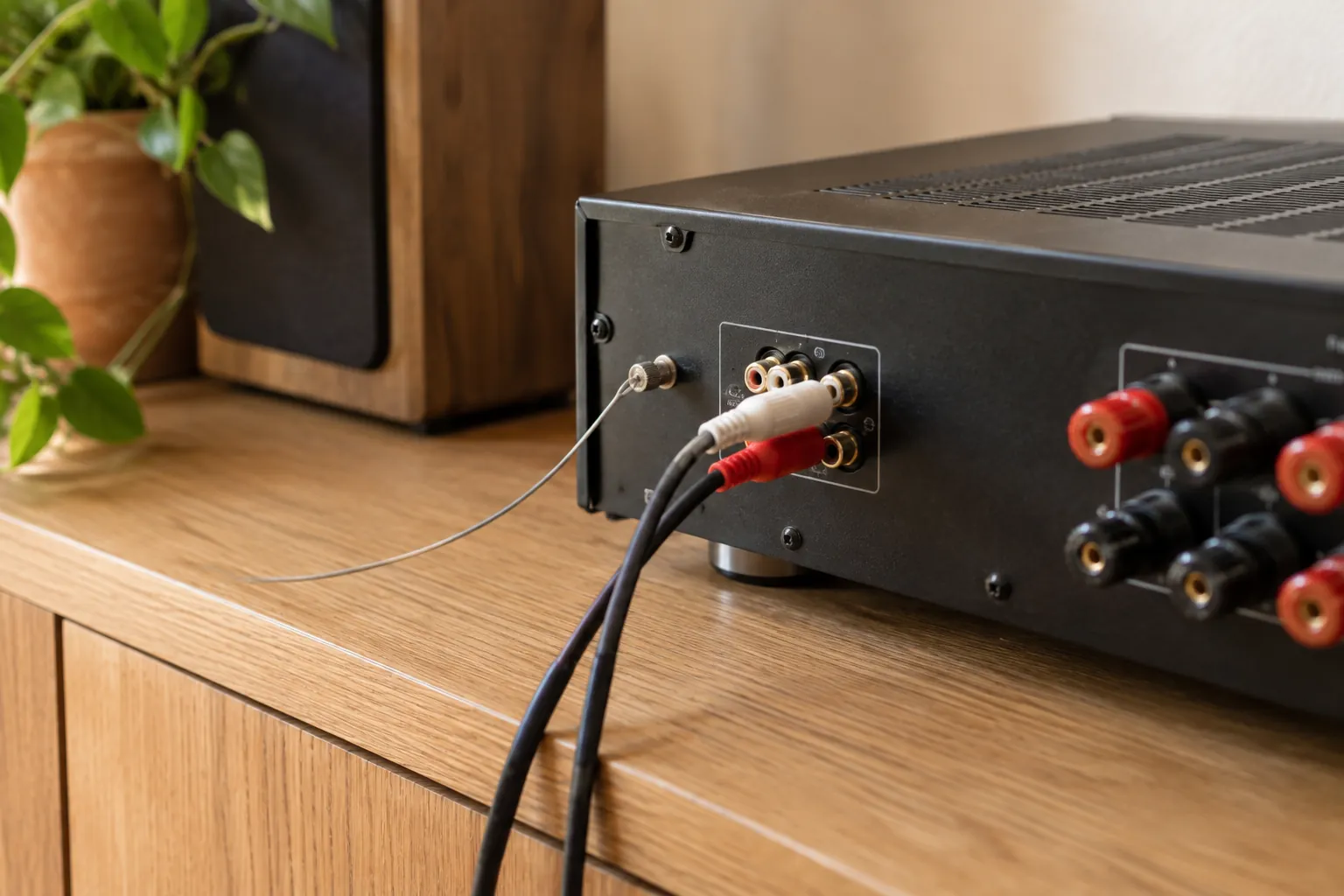
Then look at the back of your amplifier. An input marked phono, almost always with a small screw for the earth wire beside it, is a built-in preamp. All the other inputs (line, aux, CD, tuner) are line inputs and do not do that correction.
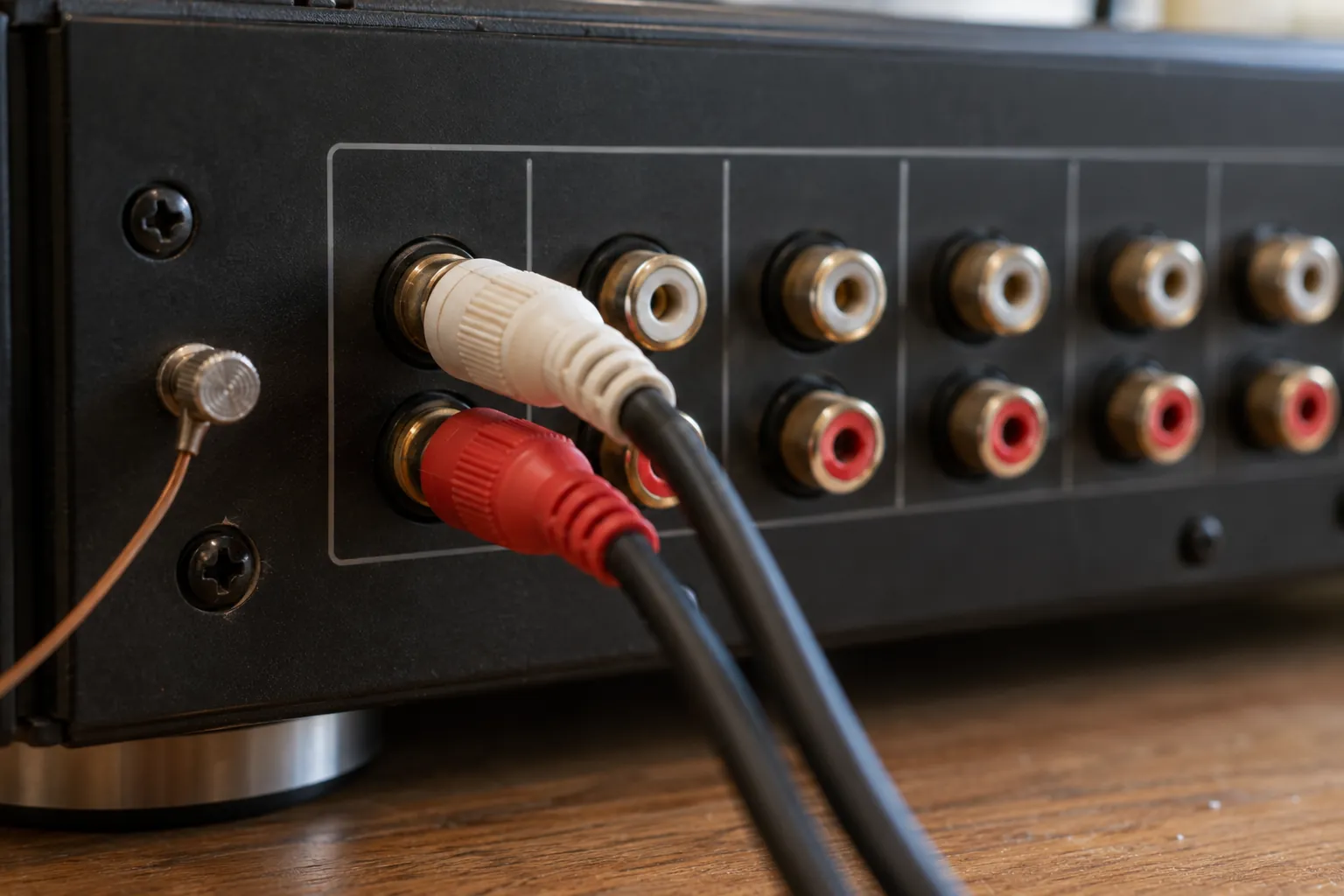
If you have neither, you buy a separate phono preamp. It is a box about the size of a pack of cards with two RCA inputs, two RCA outputs, an earth screw and a plug, and it goes between the turntable and a line input. For an MM cartridge there is no reason to spend much on it.
On an amplifier with a phono input
This is the simplest situation. Set the switch on the turntable to phono if it has one, put the red plug in the right-hand socket of the phono pair and the white in the left, and screw the thin earth wire from the turntable onto the earth screw by that input. Select the phono input on the amplifier and you are done.
Make sure you do not forget the earth wire. It hangs loose from the back of the turntable and looks like a forgotten bit of wire with a fork or a ring on the end, but without that connection you hear a constant hum as soon as the volume goes up. And never plug the turntable into a phono input while its own preamp is switched on: that is the double amplification that distorts.
On an amplifier or receiver without a phono input
If your amplifier only has line, aux or CD inputs, set the switch on the turntable to line and connect it to one of those. If your turntable has no such switch, a separate preamp goes in between first: turntable to the input of the box, box to the line input of the amplifier, earth wire from the turntable to the box.
A modern TV receiver or soundbar often has only digital inputs, and a turntable cannot plug into those. Look for an analogue input (two RCA sockets, white and red) or use a separate preamp with a digital output. A simple adapter from RCA to optical does not exist, because there is a conversion in between that you have to buy.
On active speakers
Active speakers have the amplifier built in, so the cable goes straight from the turntable to the speaker. On most pairs all the connections are on one of the two speakers, with a separate cable to the second; that speaker also needs the socket, so decide beforehand which side it will be.
Look carefully at the input here. If the speaker has a phono input with an earth screw, a turntable without a built-in preamp can go straight in. If it only has a line or aux input, set the turntable to line or use a separate preamp. This is where it goes wrong most often: a phono signal into a line input sounds quiet and tinny, and many people then think the speaker is broken.
Speaker cable for passive speakers
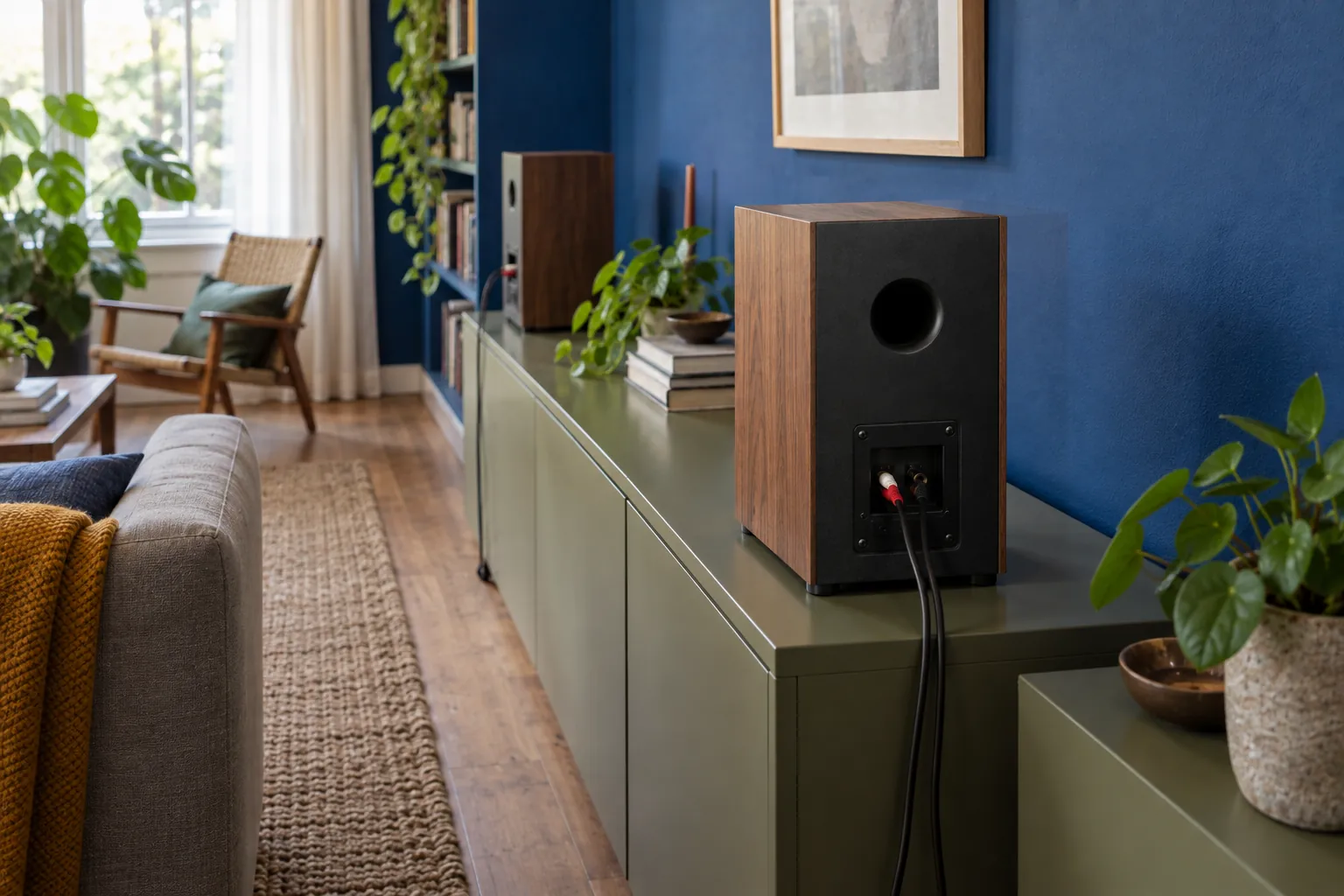
Passive speakers get their signal from the amplifier through speaker cable, two cores per speaker. Connect left and right the same way: plus to plus, minus to minus. On almost all cable one core is marked with a stripe, a colour or a ridge so you can tell which is which, and that is all you need to know.
Reverse one speaker and they are out of phase: the bass gets thin and the image between the speakers falls apart. It is a ten-second mistake and just as quick to fix. Also make sure no stray strands hang over the terminals, because two strands touching trips the amplifier's protection.
On cable quality: a short, solid cable with a decent cross-section does what it needs to do in a living room. Measure the distance, add half a metre of slack and buy both sides the same length. Money you spend on exotic cables you do not hear back; the same money spent on better placement or a clean record, you do.
When it hums, sounds quiet or distorts
A constant hum that gets louder with the volume is almost always the earth wire: not connected, or connected to something that is not earthed itself. Connect it to the earth screw by the phono input or to the preamp box. If it keeps humming, move the RCA cable further from power cables and power strips, and plug the turntable and amplifier into the same power strip.
Very quiet sound where you have to turn the volume right up means a phono signal going into a line input: a preamp is missing. Harsh, distorted sound at a quarter volume means the opposite, two preamps in a row; set the switch on the turntable to line or take the separate box out.
If you only hear one channel, an RCA plug is loose or not pushed far enough into the socket, or a speaker wire has come off. Swap the two RCA plugs over: if the silence moves to the other channel, it is the cable or the turntable; if it stays on the same side, it is the amplifier or the speaker.
Take a photo before you unplug anything
Photograph the back of your equipment before you start moving things. Simple, but it saves a lot of trouble with faults and house moves. Stick a bit of tape on two cables if you need to.
Then change one thing at a time. That way you also know which change had an effect.
Frequently asked questions
- How do you connect a turntable to an amplifier?
- With an RCA cable from the turntable's output to an input on the amplifier: white is left, red is right. If the amplifier has a phono input with an earth screw, use it and screw the turntable's earth wire onto it. If it does not, set the turntable to line or use a separate phono preamp.
- Can a turntable connect directly to active speakers?
- Yes, as long as there is exactly one phono preamp in the chain. If the speaker has a phono input, any turntable can go straight in. If it only has line or aux, the turntable must have its own preamp switched on, or a separate box goes in between. If it sounds quiet and tinny, that preamp is missing.
- Why does my turntable hum?
- Almost always the earth wire. That thin wire on the back of the turntable belongs on the earth screw by the phono input or on the preamp box. If it keeps humming, move the RCA cable further from power cables and plug the turntable and amplifier into the same power strip.
- Do you need expensive cables for a turntable?
- No. A short, solid RCA cable and speaker cable with a decent cross-section do what they need to do in a living room. Measure the distance, allow half a metre of slack and buy both sides the same length. You will not hear the difference exotic cables promise; you will hear better placement or a clean record.