
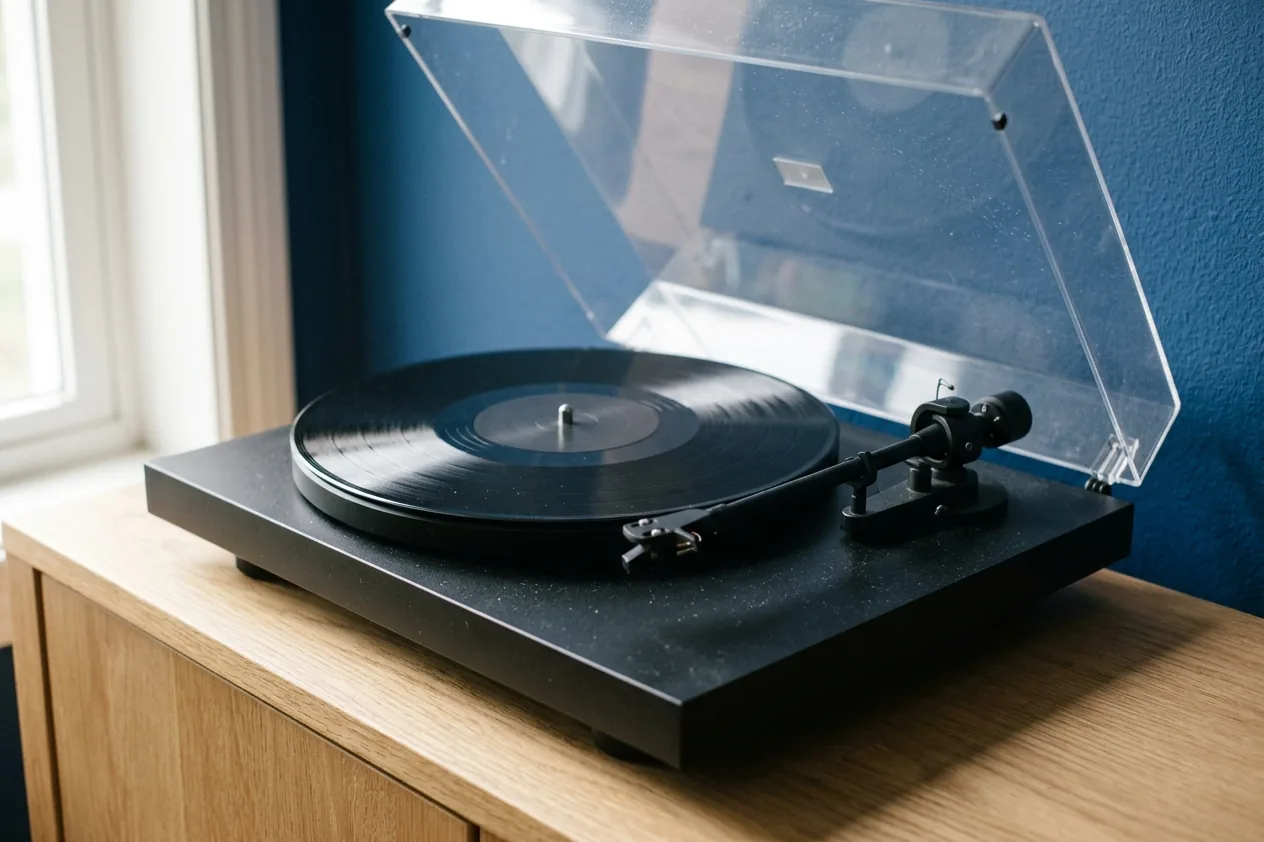
The problem: You want to buy a turntable, but every comparison ends in an argument about individual parts.
The short route: Start with how you will use it and what it will be plugged into. Cartridges and drive types come after that.
How often will you really use it?
A turntable lives in a room with dust, vibration and evenings when you are in a hurry. So ask yourself first how often you will actually put a record on, and whether you enjoy fiddling with settings. If you mostly want to play records without fuss, a simple player that is set up properly will serve you better than an ambitious model that never gets set up right.
Think about the rest of the chain straight away. If you have active speakers or a basic amplifier, a turntable with a built-in preamp is the easiest choice. If you want to be able to upgrade later, pick one where that preamp can be switched off or bypassed. That leaves room to grow without buying everything today.
There is one more question that rarely gets asked: who will be using it? Lowering the arm by hand is second nature to a practised listener, but in a household where children or guests also want to play a record, an automatic arm prevents more damage than it costs in sound.
Belt drive or direct drive
On a belt-driven turntable the motor sits beside the platter and turns it through a rubber belt. The belt absorbs motor vibration before it reaches the record, which is why almost every turntable for home use is built this way. The drawback is small: after a few years the belt stretches and needs replacing, a job of a few minutes and a few tens of euros.
On a direct-drive turntable the motor sits under the platter and turns it directly. The platter gets up to speed faster and holds that speed more tightly, which DJs need because they slow the record by hand and let it go. For listening at home that advantage is barely audible, and the motor sits closer to the stylus. A good direct drive is no worse than a good belt drive, but on the same budget a belt usually gives you the quieter player.
So do not let a salesperson rush you into direct drive as the more serious option. Look at how the whole turntable is built, and treat the drive as a choice about how you use it: belt for listening, direct drive if you want to scratch or mix.
The cartridge and the stylus
The cartridge sits at the front of the tonearm and turns the movement of the stylus into an electrical signal. Almost every turntable under a thousand euros comes with an MM (moving magnet) cartridge, and that is exactly right: the stylus can be replaced on its own, the signal is strong enough for any preamp and there is a wide choice of replacement styli. An MC (moving coil) cartridge sounds more refined at the higher end, but it needs a dedicated preamp and you cannot replace the stylus yourself. For a first or second turntable that is a step you can take later.
More important than the type is whether the stylus can be replaced and whether the replacement is still made. A stylus wears, however careful you are, and a turntable with an exotic cartridge whose stylus is no longer available becomes a problem after a few years. Ask which cartridge is fitted when you buy, and check that the replacement stylus is easy to get. How to tell when a stylus is worn is covered in the guide on replacing the stylus.
The shape of the stylus tip makes a difference too. A conical stylus is the cheapest and the least fussy to set up; an elliptical stylus follows the groove more precisely and gets more detail out of a record, but it needs a correctly set tracking force. For a beginner, an elliptical stylus on a properly set up cartridge is the best balance between sound and ease.
The preamp: built in or separate
The signal from a cartridge is very weak and needs correcting before an amplifier can do anything with it. That is the job of the phono preamp. It can sit in one of three places: in the turntable, in the amplifier (an input marked phono) or in a small separate box in between. You need exactly one. Two in a row gives a loud, distorted sound; none at all gives a quiet, thin sound with no bass.
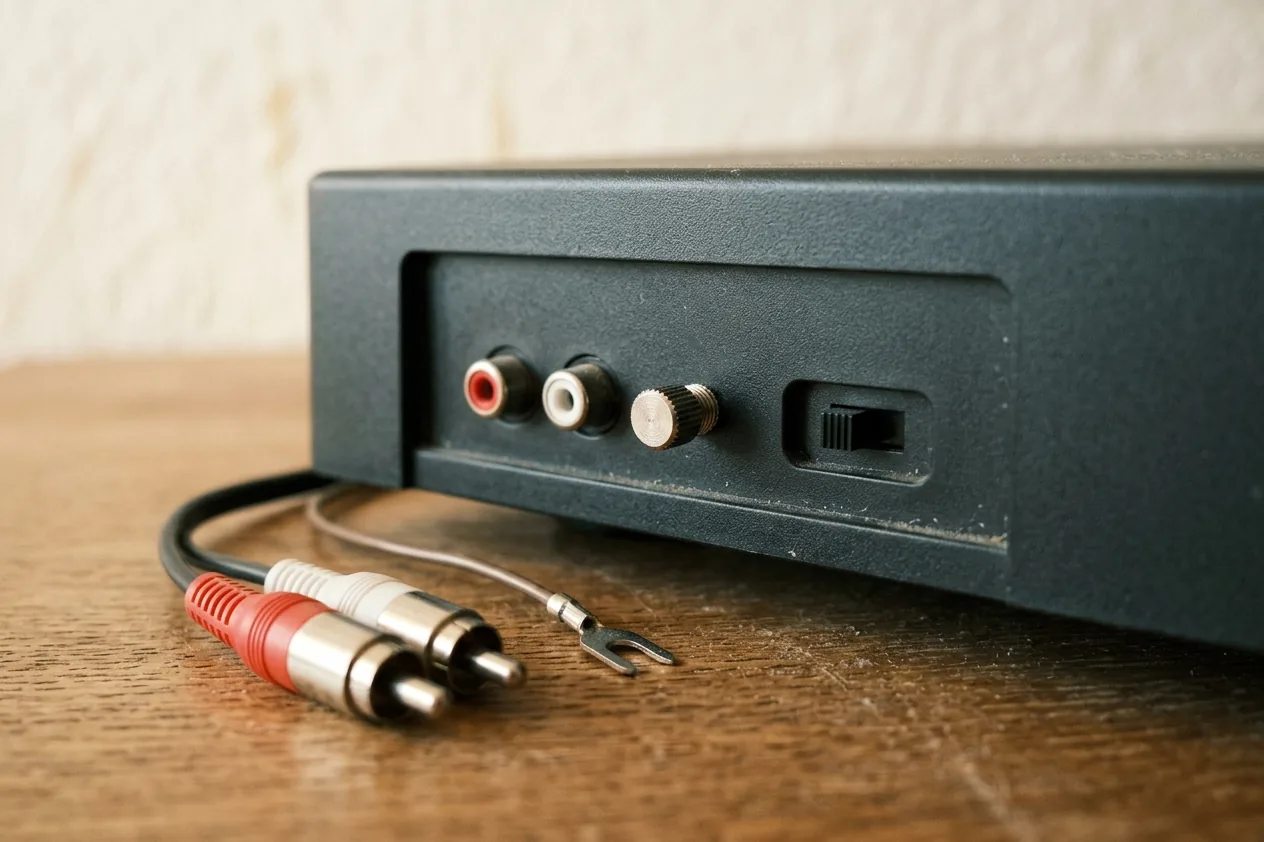
So look at what you already have. If your amplifier has a phono input, the turntable can do without a built-in preamp, or have one you can switch off. If you have active speakers, a soundbar or an amplifier with only line inputs, a turntable with a built-in preamp is the simplest route. The switch on the back, usually marked phono and line, decides which of the two you use.
A turntable with a preamp you can switch off is the safest buy, because it can move with you to a different amplifier. Bluetooth is a nice extra if you already have wireless speakers, but it is an output alongside the cable, not a replacement: the cable sounds better and works without pairing. If you do not need it, do not pay for it.
Where the money makes a difference
Look mainly at how it is built. A stable platter, a decent tonearm and a good setup do more for the sound than a row of extra features. Next comes the cartridge, the part that reads the groove. Choose one with a replaceable stylus, because it will wear whatever you do, and then replacing it is quick.
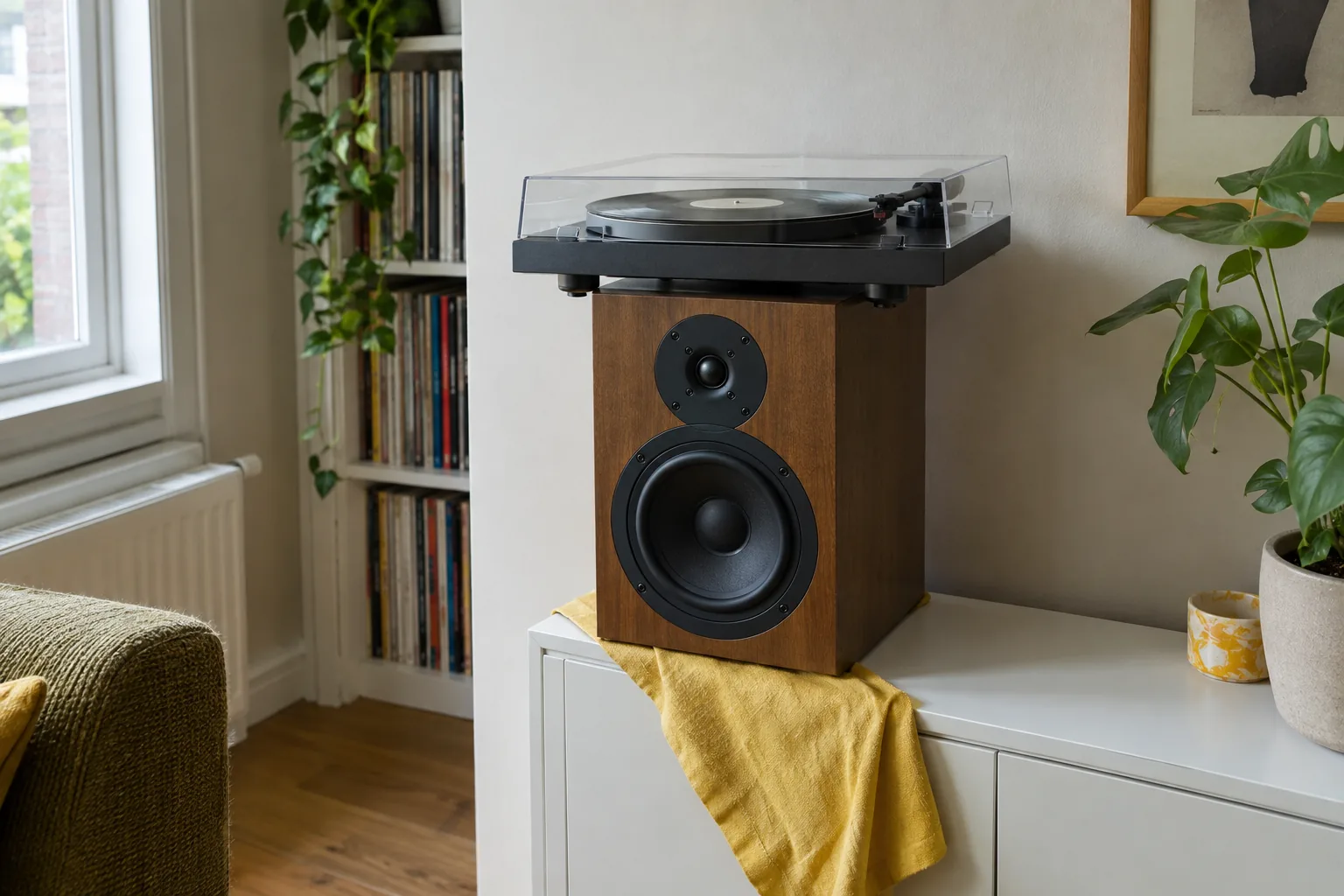
Then there is where it stands. Do not put the turntable on the same cabinet as a speaker, or on furniture that gives when you walk past. A solid base helps the stylus stay in the groove. A modest turntable in a quiet spot often sounds nicer than an expensive one on a cabinet that shakes.
What you can expect at each price shifts over time, but the proportions have stayed the same for years. Around one to two hundred euros buys a fully automatic turntable with a built-in preamp and a replaceable conical or elliptical stylus; it sounds tidy and asks for no knowledge. Between three and five hundred euros you get a manual belt-driven turntable with a heavier platter, a better tonearm and a cartridge worth upgrading later. Above that you pay for materials, precision and finish, and the rest of your system decides whether you actually hear the difference.
A mid-range turntable in a good spot, with a clean record and a correctly set tracking force, sounds better than an expensive one on a wobbly cabinet. The money you save is usually better spent on the speakers or on records.
New or second-hand
A second-hand turntable from the seventies or eighties can be excellent: the build quality of that era is often better than what the same money buys new today. There are conditions, though. The belt, the stylus and sometimes the bearings are worn, and the question is whether replacement parts are still available. With a used turntable, budget for a new stylus and a new belt on top of the price, and check that the arm still moves smoothly and the platter gets up to speed without wobbling.
Buying new gets you a warranty, a correctly set up cartridge and usually a built-in preamp. If you have no wish to set up an old turntable, that is worth the money. If you enjoy tinkering, second-hand often gets you more turntable for less. The guide on buying second-hand records is about the records themselves; for the turntable the same careful eye applies, plus an ear for the motor.
Do not buy for a hobby you do not have
An upgrade path is only worth something if you will actually tinker. If not, you are better off with a system that is complete from day one. Keep money back for records, a brush and a good spot in the room instead. None of that looks exciting in a brochure, but it decides whether the turntable becomes an ornament or something you use every week.
When you buy, ask how it will arrive. Is the counterweight set? Is the cartridge already fitted? Which cable do you need for your amplifier? A seller who answers that straight away is a better sign than one who mainly lists the most expensive specifications.
And when you get home: make it level, set the tracking force to what the cartridge maker specifies, connect the earth wire if there is one, and play a record you know well. If it sounds the way you know it, the rest is detail.
Frequently asked questions
- Which turntable is good for a beginner?
- A belt-driven turntable with an MM cartridge, a replaceable stylus and a built-in preamp you can switch off. Fully automatic if other people at home will use it too, manual if you want to set it up yourself. More important than the brand is that it is set up properly on a solid, level surface.
- Do I need an amplifier for a turntable?
- Yes. The signal from a turntable has to be amplified before a speaker can make sound from it. That can be a separate amplifier with passive speakers, or a pair of active speakers with the amplifier built in. On top of that you need exactly one phono preamp: in the turntable, in the amplifier or as a separate box.
- Is a turntable with Bluetooth a good idea?
- If you already have wireless speakers and do not want to run a cable, it is a nice extra. It is an output alongside the cable, not a replacement: the same turntable sounds better over the cable and works without pairing. If you do not have wireless speakers, do not pay for it.
- What is the difference between an MM and an MC cartridge?
- In an MM cartridge the magnet moves and the stylus can be replaced on its own; the signal is strong enough for any phono input. In an MC cartridge the coil moves, the signal is much weaker and needs a dedicated preamp, and you cannot replace the stylus yourself. Under a thousand euros, MM is the standard and the right choice.