
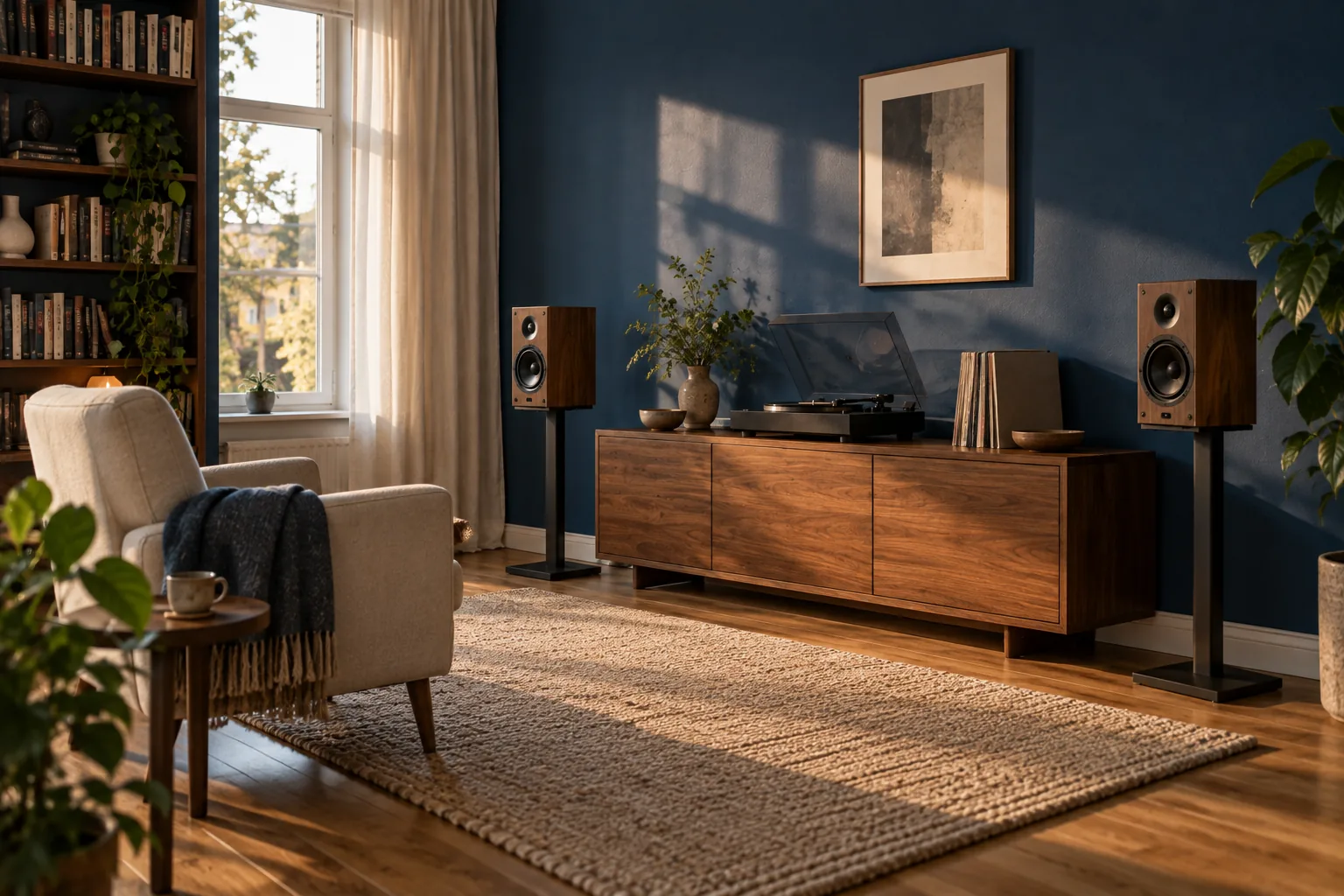
The problem: Your living room has to be all sorts of things at once, and still you want a spot where music does not fade into the background.
The short route: Start with your chair and build the rest around it, not with a cabinet full of equipment.
The chair first, then the rest
A listening corner starts where you sit, for a simple reason: everything you buy or move afterwards is aimed at that spot. So choose the chair first, and choose one you can sit in for twenty minutes without shifting about. That is a lower bar than it sounds. Plenty of people listen standing up or perched on the arm of the sofa, find it uncomfortable and conclude that the music is not holding them.
Pick one. A listening corner has one seat that is right, not a sofa where three people sit equally well; that does not exist in an ordinary room. On a sofa there is one place where left and right are the same distance away, and that is usually the middle. Know which place that is and you know what to aim everything else at.
The chair you already have is almost always good enough. What does matter is the back: if your head rests against a high back or against a wall, the sound bounces back right behind your ears. A hand's width of space behind your head is enough to prevent that, and that is usually a matter of moving the chair forward a little.
Where in the room it fits
Find a wall where the cabinet can stand and where a socket is within reach. That sounds mundane, but it moves more listening corners than any acoustic argument: a setup with an extension lead across the walkway gets taken down again. Count the sockets too. A turntable, an amplifier and a lamp make three, and a power strip behind the cabinet solves that neatly.
The long wall or the short wall matters less at the start than people often say. What does matter: do not put the cabinet against the radiator, in full sun or against the wall shared with the neighbours' bedroom. Heat and sun warp records and fade sleeves, and the third is about avoiding a row later.
Keep the walkway clear. A listening corner in the path to the kitchen is a corner you walk around every evening and, in practice, never sit in. The corner of the room nobody crosses is almost always the right one, even if it is not the prettiest.
The setup in one paragraph
You do not need to measure out a triangle. Make sure the two speakers are roughly the same distance from your chair, that they are roughly as far apart as you are from them, and that they both have about the same space to the side wall. Do that by eye, then put on a record you know well, and you will hear for yourself whether the centre is in the centre.
Height comes second: the tweeter belongs roughly at ear height when you are sitting. Bookshelf speakers on a cabinet are usually too high and on the floor too low, which is exactly why stands exist. How much distance a speaker needs from the back wall and how far it should be angled in depends on the room and is covered in the guide on choosing speakers.
Moving things costs nothing and works better than almost anything you can buy. A few centimetres forward takes a speaker out of the boom of the wall, and moving the sofa half a metre out of the corner does more than a more expensive amplifier. Give it an evening with the same record, and change one thing at a time.
What the equipment stands on
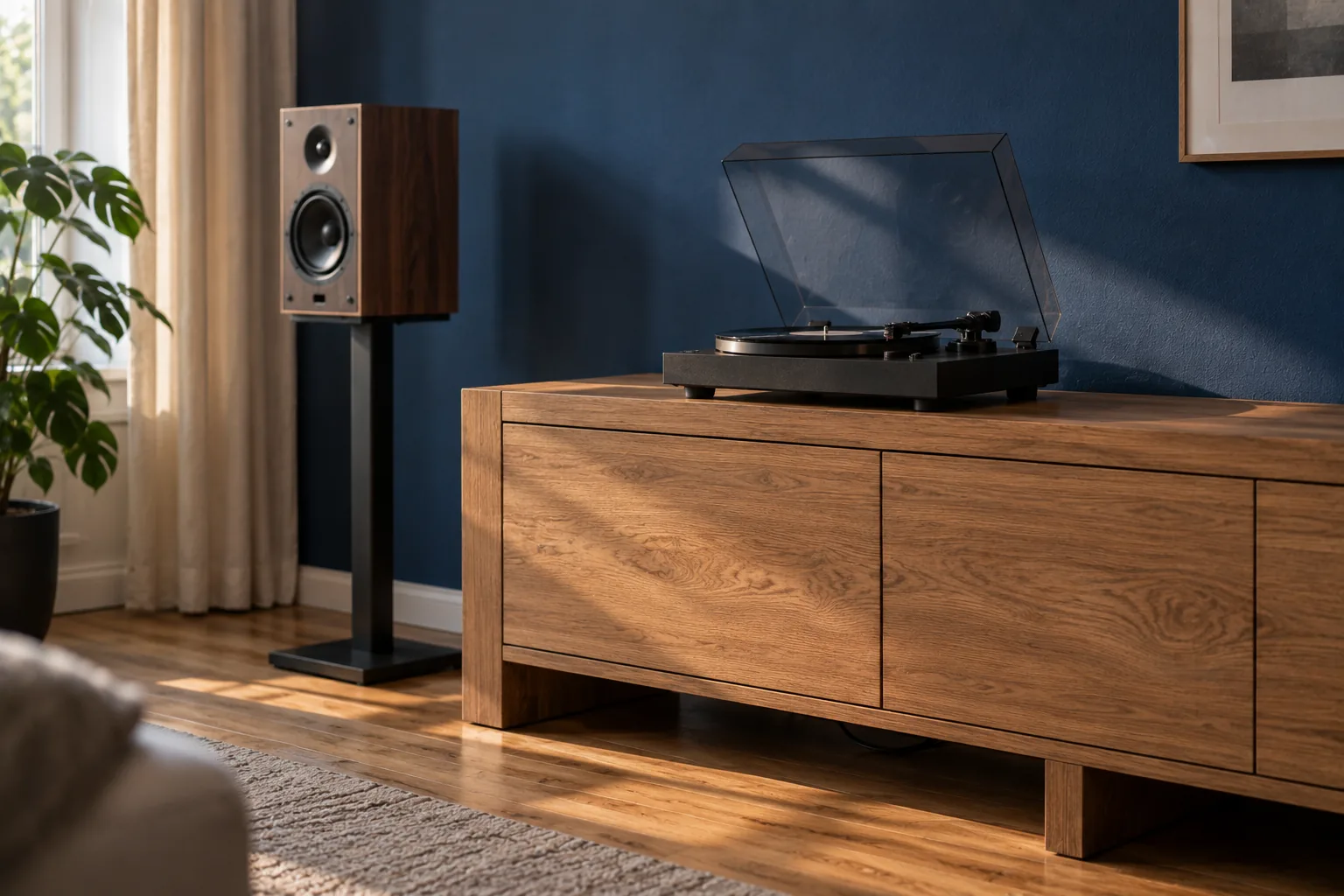
The furniture is not a detail. A turntable wants a level, solid surface that does not vibrate along with everything else: a wobbly side table makes the stylus follow your footsteps, and on a floating floor that is audible as a dull boom in louder passages. A low, heavy cabinet against the wall is the simplest solution and also the cheapest, because it is usually the cabinet you already have.
Preferably do not put the speakers on the same piece of furniture as the turntable. They make the top vibrate, and that travels through the cabinet back to the stylus. If there is no other option, keep as much distance as you can and put something soft under the speakers. Stands next to the cabinet are better, and they solve the height at the same time.
If records are going in the cabinet too, measure the depth first: an LP sleeve is just over 31 centimetres and a cabinet needs to be at least 33 centimetres deep, or the sleeves stick out and those are exactly the edges that get damaged. Which cabinet can do it is covered in the guide on buying a record cabinet. Allow for over twenty kilos per hundred records, and fix a tall cabinet to the wall.
Finally, think about the cables before the cabinet goes against the wall. A turntable needs an RCA cable and usually an earth wire, and they need enough length for you to pull the cabinet out again. How that connection works exactly, and when you need a separate phono preamp, is covered in the guide on connecting your turntable.
Make starting effortless
A setup you can get going within a minute gets used a few times a week. A setup where you first have to find an adapter gets used at Christmas. That difference is almost entirely about where things are kept, not about what they cost.
Give the brush, the remote and the cloth a fixed place within reach of the chair. A small side table or the top of the cabinet is enough. Put the sleeve of the record that is playing there too: then it is not on the floor against a chair leg, which is the most common way a sleeve gets damaged.
Keep twenty records within reach and the rest in the cabinet. A crate next to the chair with whatever you are playing these weeks saves a search through the whole collection every evening, and that is exactly the moment people reach for their phone instead. How to store the rest without the room turning into a warehouse is covered in the guide on storing records.
Light changes the pace of the room
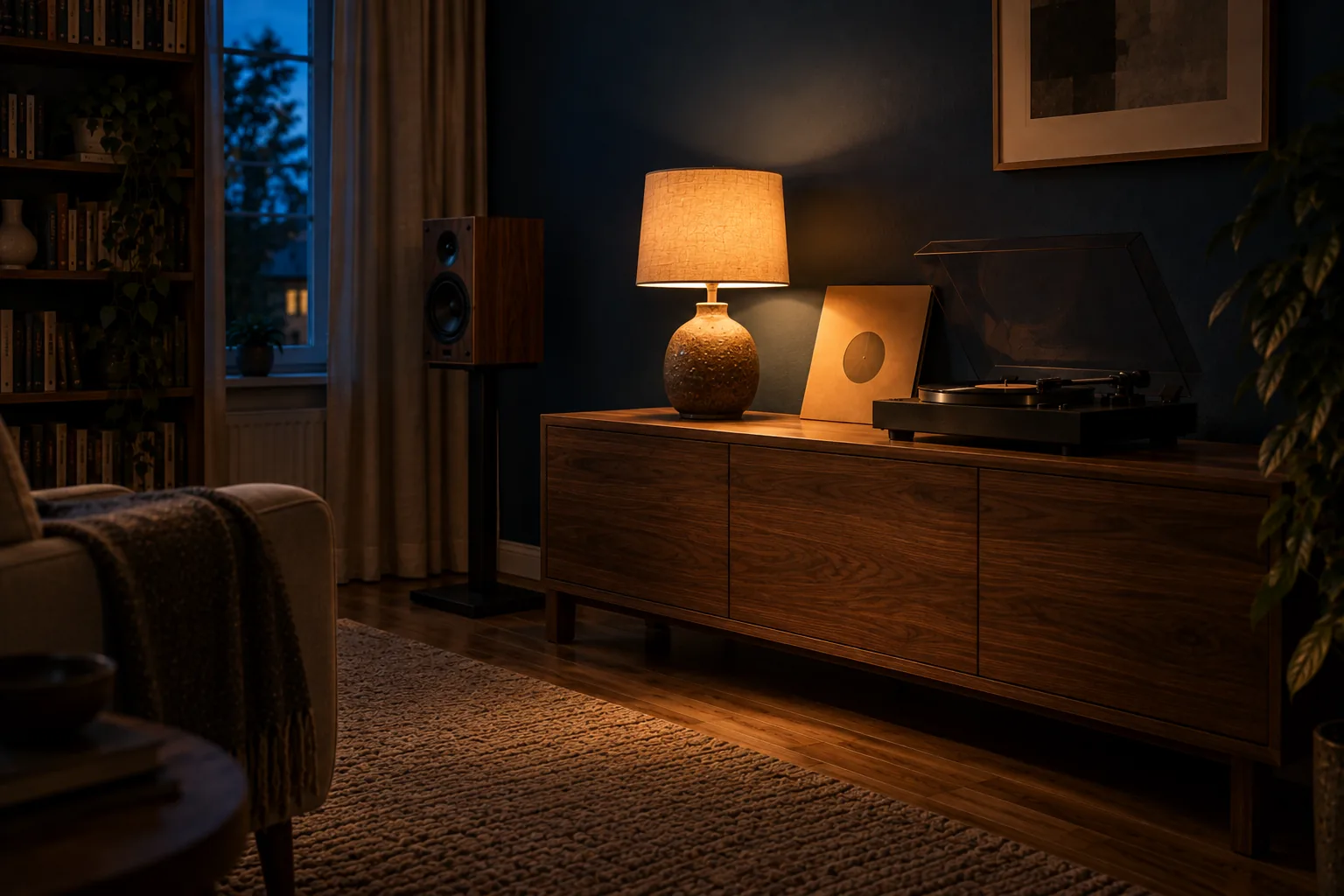
One directed lamp by the cabinet does more for a listening corner than most purchases. With the ceiling light off and a lamp that makes the sleeve readable, the room changes from a place where you do things into a place where you sit. That is not talk about atmosphere but practice: you need to be able to read the sleeve and the side, and you want to see the stylus go down without a torch.
A warm lamp of around 2700 kelvin with a dimmer is enough. Put it beside the cabinet and not behind your head, so your own shadow does not fall right across the turntable. A lamp with a shade that keeps the light pointing down works better than a bright spotlight: you want to light the sleeve, not the room.
A showroom does not sound better
A bare room with a hard floor and empty walls sounds harsh and echoes, and you hear that first in voices. The solution is usually already in the house. A rug between you and the speakers, curtains on the window side, a full bookcase against a bare wall: those are the three things that do the most, in that order, and they are also the three things nobody in the room has an opinion about.
Acoustic panels are almost never the first step for an ordinary living room, and a room full of foam sounds dull rather than good. You are not after studio silence. You want a room that stays pleasant with a loud record and with a quiet recording, and that line is lower than the internet suggests.
Start with what you have and change one thing at a time. Put the rug down, listen for a week, close the curtains, listen for another week. Change everything at once and afterwards you do not know what did what, and then you buy things that did nothing.
When the room belongs to others too
Most listening corners are in a room that is also a TV room, a workspace and a playroom. That does not have to be a compromise, as long as you accept that the listening chair is not the TV chair. An armchair angled towards the cabinet, beside the sofa rather than opposite it, works better in many living rooms than rearranging the whole room.
If the TV is between the speakers, keep the screen as far back as possible and bring the speakers forward a little. A large smooth screen right between two speakers bounces sound back, which is why a setup around the TV often sounds a bit hard.
For evenings when it has to stay quiet, headphones are not a second choice but a second setup. They solve the neighbour and housemate problem without changing the room, and they make listening possible at the hours when most people have time for it. What suits that is covered in the guide on listening with headphones.
What it costs, and in what order
The first round costs nothing. Moving the chair, taking the speakers out of the corner, putting the rug that is already in the hall under the chair and giving things a fixed place: that is an afternoon's work, and it is also the round that makes the biggest difference.
The second round is small and targeted. A pair of speaker stands costs fifty to a hundred and fifty euros and puts the tweeters at the right height; a lamp with a dimmer costs a few tens of euros; a crate beside the chair a few tens of euros. Together that stays well under two hundred euros and it changes more than an amplifier in the same price range.
Only then does equipment come into it, and by then you know what you are buying for. A room where you have really been sitting and listening for a few months tells you what is missing. It rarely works the other way round: an expensive system in a room with no fixed place to sit becomes a cabinet full of devices.
Frequently asked questions
- How big does a listening corner need to be?
- There is no minimum. What you need is a chair with space behind your head, two speakers roughly the same distance from that chair and a solid surface for the turntable. That fits in a corner of two by two metres. A small room is not a problem; a room where the listening spot is in the walkway is, because you will not sit there.
- Where is the best place to put a turntable?
- On a level, solid and preferably heavy piece of furniture against the wall, at a height where you can see the stylus go down. Not on the same top as the speakers, because they make the furniture vibrate and that comes back to the stylus. On a floating wooden floor it helps to put the cabinet against a load-bearing wall.
- Do you need acoustic panels in a living room?
- Almost never as a first step. A rug between you and the speakers, curtains on the window side and a full bookcase against a bare wall do most of the work, and they are usually already in the house. Panels only make sense in a genuinely bare room with a hard floor and empty walls, and a room full of foam sounds dull.
- Can a listening corner work in a room with a TV?
- Yes, as long as the listening chair does not have to be the TV chair. An armchair angled towards the cabinet works better in most living rooms than rearranging everything. If the TV is between the speakers, put the screen as far back as possible and the speakers a little forward, because a large smooth screen bounces sound back.