
The problem: Your records are growing faster than your cabinet, and you want to protect them without setting up a warehouse.
The short route: Store them upright, not too tight, and in blocks you can move easily.
Upright, supported and easy to reach
Good record storage comes down to three things: the records stand upright, the cabinet is the right size, and there is a storage system you still keep up after a year. That last one does not have to be complicated, as long as you put a record back where you took it from.
Stand records upright, like books, but do not wedge them together. A row that is too loose falls over; a row that is too tight damages the sleeves. Use a sturdy cabinet with dividers once the row gets long.
Keep them away from radiators, out of direct sunlight and off damp outside walls. Card and vinyl cope badly with swings in temperature and humidity.
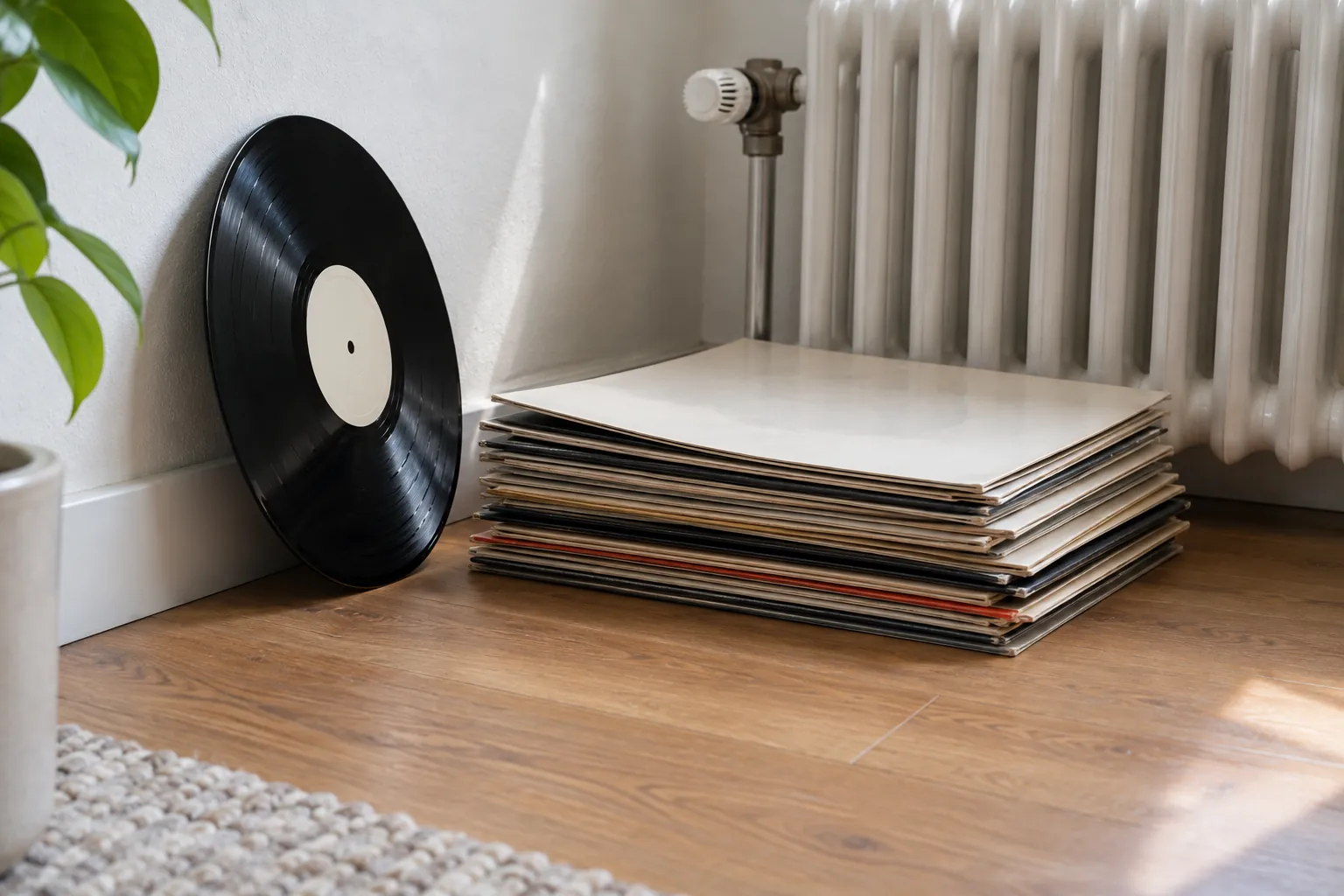
Stacking flat is the one method that always goes wrong. The weight of the records on top presses the bottom ones into their sleeves, the sleeves get ring wear and the records themselves can warp after a warm summer. Leaning them at an angle against a wall is the second: a record that stands at an angle for weeks takes on that angle. Upright, supported on both sides, is the whole secret.
Which record cabinet
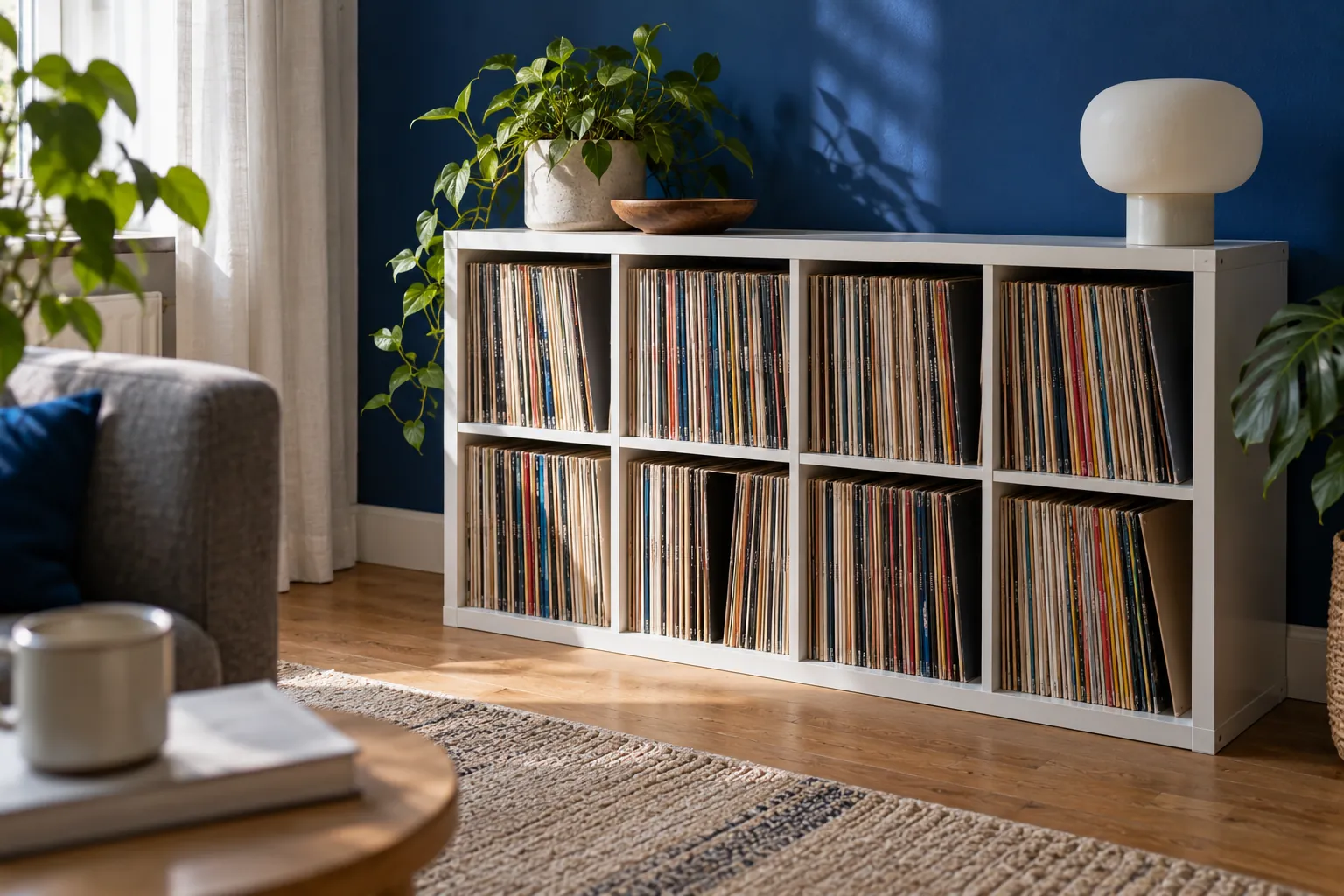
An LP sleeve is about 31.5 by 31.5 centimetres. A compartment therefore needs to be at least 33 centimetres high and deep, and that is exactly why the familiar cube shelf with 33-centimetre compartments has become the standard: it fits, it is cheap and it holds every other record collection. One compartment 33 centimetres wide takes about 50 to 60 records, depending on how many double albums and outer sleeves are among them. A unit with four compartments is good for about 200 records, eight compartments for 400.
Watch two things. The first is the shelf: a hundred records weigh over twenty kilos, and a long shelf without a divider sags and squeezes the sleeves. Choose a cabinet with compartments or put a divider every sixty centimetres. The second is the depth: a 30-centimetre cabinet leaves the sleeves sticking out, and that is what damages them.
Which cabinet suits which collection, and what each type costs, is covered in the guide on buying a record cabinet. If you want to go a step further, look at cabinets made specifically for records, with compartments where the records lean slightly forward so you can flip through them like a crate. They cost several times as much as a cube shelf and are worth it if you browse often rather than pick. For most living rooms, the cube shelf, well filled and in the right spot, is exactly enough.
A storage system that makes choosing easier
A storage system for records is nothing more than a fixed order plus a place for what falls outside it. Alphabetical is handy but not required. You can also make a small crate for what you want to play this month and sort the rest by artist or genre. With a visible selection like that, it is not always the same five records on top.
Keep new purchases apart for a while until you have listened to and cleaned them. That way a record does not vanish into the mass straight away, and later you still remember why you bought it.
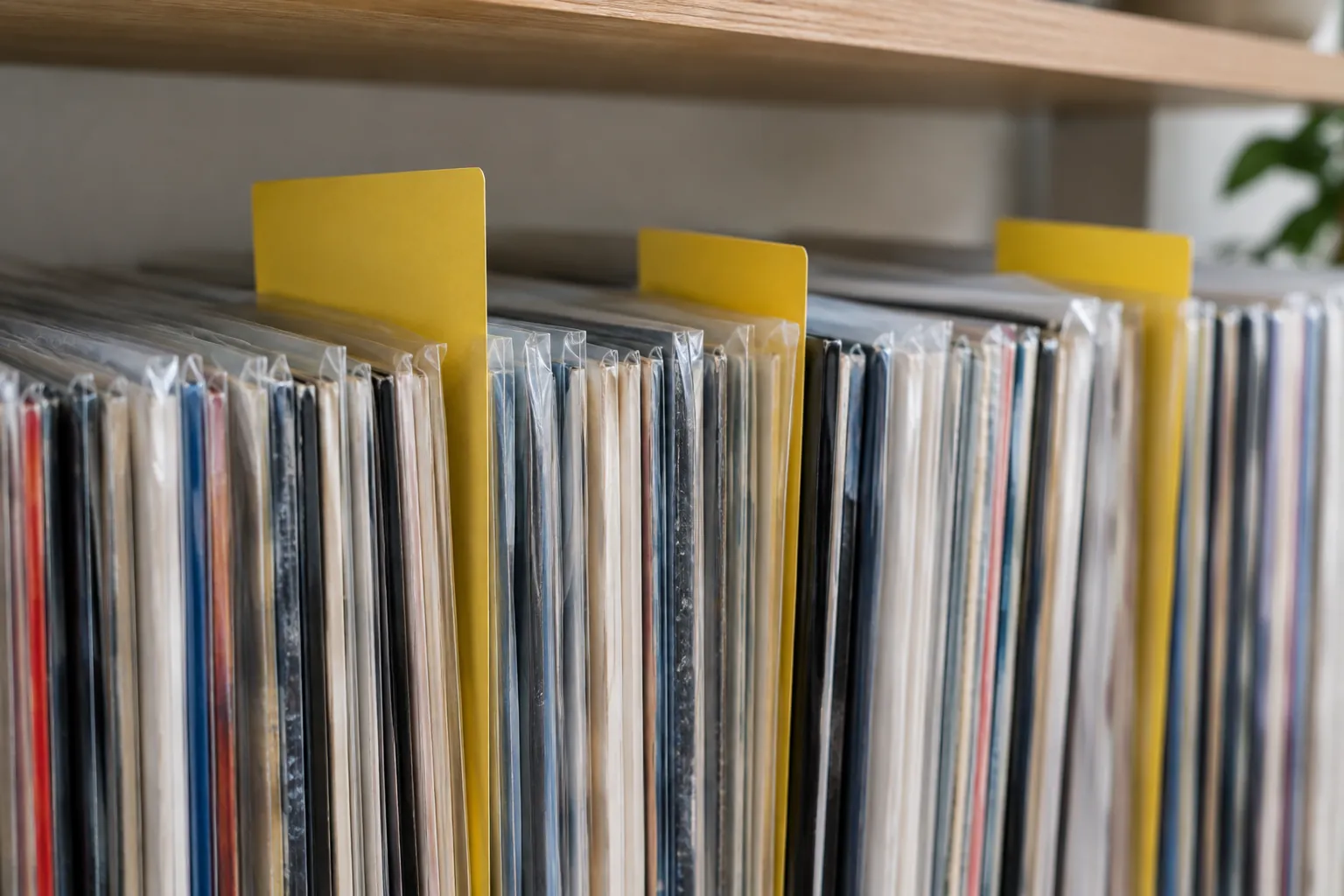
Dividers of stiff card or plastic, a little taller than the records, make any system usable: they keep a row upright when a compartment is half empty, and they mark where a letter or genre starts without you having to search. How best to sort a collection of a hundred records is covered in the guide on organising your first hundred records.
Where the cabinet must not stand
Vinyl starts to soften at about 40 degrees, and the temperature above a radiator or behind a south-facing window reaches that easily in summer. A record that warps cannot be straightened again. So put the cabinet against an inside wall, out of the sun, and not next to the heating. An attic or garage with big temperature swings is the worst storeroom imaginable.
Damp is the second enemy, and it goes for the card. A damp outside wall or a cellar makes sleeves limp and mouldy, and you can still smell that years later. A living room with normal humidity is fine; that is also where you play the records, so that is where they belong.
Protect only where it solves something
Outer sleeves help with fragile covers and with records you handle often. Use them selectively. Your collection is still something to use and does not have to disappear into plastic.
A good cabinet, tidy inner sleeves and a fixed place do more than a drawer full of accessories. Precisely because it stays simple, you keep it up.
What every record does deserve is a good inner sleeve. The paper sleeve from the factory sheds fibres and charges the record with static; an anti-static inner sleeve of polyethylene or lined paper costs a few cents each and keeps a cleaned record clean. Keep the original inner sleeve with it if it is printed, flat in the outer sleeve next to the record, so the album stays complete.
Polyethylene outer sleeves are soft and cheap; polypropylene outer sleeves are stiffer and clearer. Both protect the cover from ring wear and rubbing, and both make each record a little thicker, so expect ten percent fewer records per compartment. Put the opening of the outer sleeve at the top or at the back, never at the front, or the record slides out when you pick it up.
Singles, box sets and double albums
Seven-inch singles are about 18 centimetres and disappear behind the big sleeves in an LP compartment. Give them a crate or box of their own, 19 centimetres deep, upright and with a divider, and they stay findable and do not wobble. The same goes for 10-inch records of 25 centimetres: keep them apart, or at the front of a compartment with a divider behind them so they do not slide back.
Box sets and thick gatefold double albums take the space of three to five ordinary records and are heavy. Put them at the start or end of a compartment against the divider, not in the middle of a row, where they push the records next to them out of true. A gatefold you open often is a prime candidate for an outer sleeve, because the fold tears first.
When the cabinet is full
A full cabinet is not a reason for a second cabinet; it is a reason to look at what is in it. Records you have not played in two years can go in a box in a dry, cool place, upright and in blocks of no more than thirty, so the box stays liftable. Anything you miss afterwards you bring back; anything you do not miss can go. A collection that fits in the room where you listen gets played more often than a collection that takes over the room.
If it keeps growing anyway, put a second cube shelf next to or on top of the first rather than adding a different kind of cabinet: the same compartment size, the same depth, and the system simply carries on.
Frequently asked questions
- What is a good storage system for records?
- A cabinet with compartments at least 33 by 33 centimetres, in which the records stand upright with support on both sides, plus a fixed order by artist or genre with dividers that stick up a little above the records. Keep a small crate as well for what you are playing now and for new purchases, so the fixed order does not get mixed up.
- How many records fit in a cube shelf?
- A 33 by 33 centimetre compartment holds about 50 to 60 LPs, a little fewer if many records have an outer sleeve or are double albums. A four-compartment unit holds about 200 records, an eight-compartment unit about 400. Allow for over twenty kilos per hundred records, so the unit must stand firmly.
- How deep does a record cabinet need to be?
- At least 33 centimetres, because an LP sleeve is about 31.5 centimetres and an outer sleeve makes it slightly larger. In a 30-centimetre-deep cabinet the sleeves stick out and the edges get damaged. The compartments also need to be at least 33 centimetres high.
- Can you store records flat?
- No. The weight of the records on top presses the bottom ones into their sleeves, the sleeves get ring wear and the records can warp, especially in the heat. Always store records upright, supported on both sides and not packed too tightly.
- Do you need outer sleeves?
- Not for every record. They protect the cover from ring wear and rubbing and are worth it for records you handle often and for fragile or valuable covers. An anti-static inner sleeve matters more, because it keeps the record itself clean. With outer sleeves, expect about ten percent fewer records per compartment.