
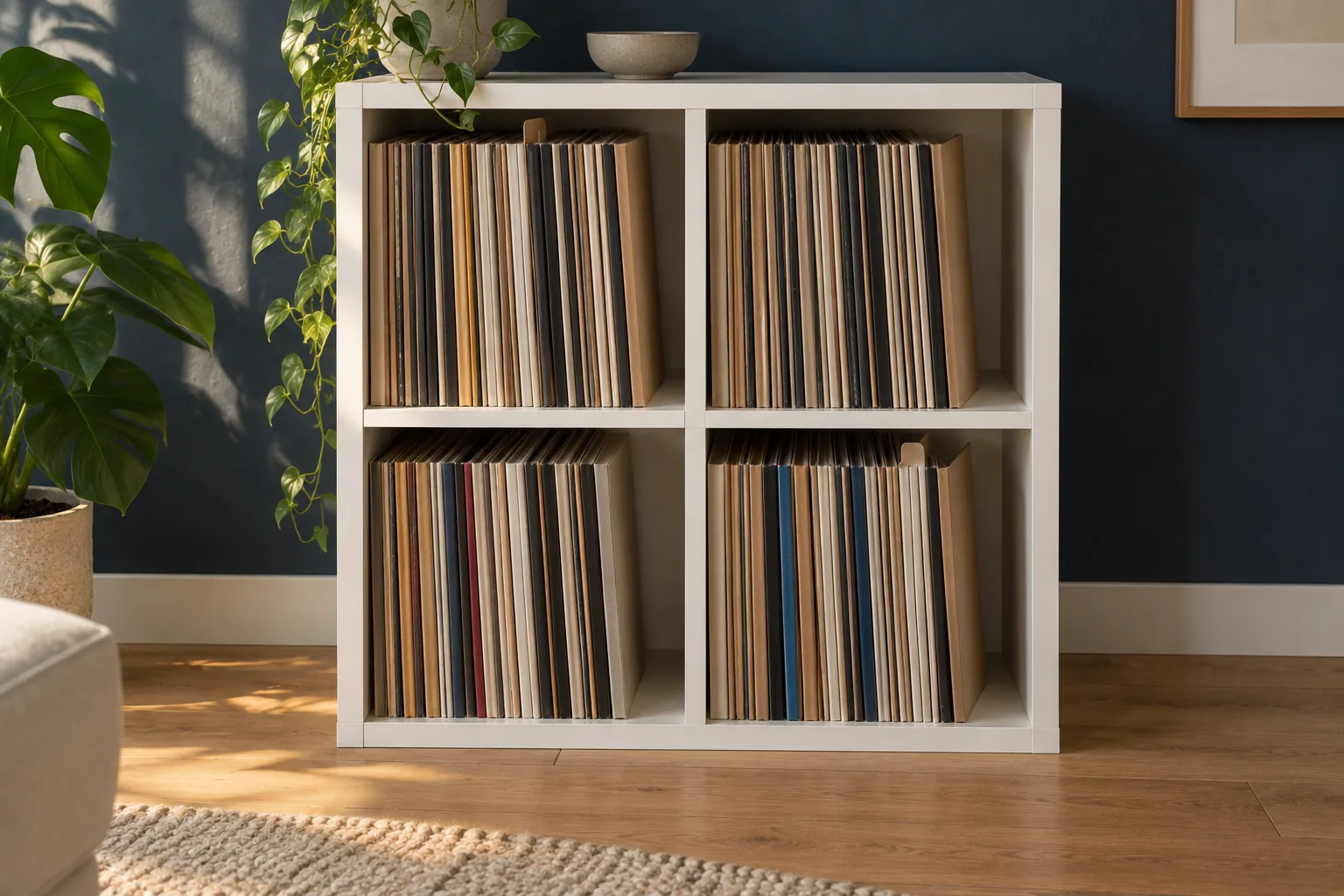
The problem: Your collection is just big enough to get messy, and every system you find online was designed for a collection much bigger than yours.
The short route: Choose the simplest system you can already keep up, settle the edge cases once, and only change it when the collection really asks for it.
Why most systems come too early
The order you see in record shops, first by genre, then by artist, then by catalogue number, is built for a stock of thousands of records and for people who do not have to live in it. With a hundred records that system costs more time than it saves: you stand there wondering whether a record belongs under soul or funk, while alphabetical by artist gets you to the same sleeve in seconds.
The real price of a system is the number of decisions per record. One decision when you put a record back, you keep up for years. Three decisions you keep up for two weeks, and after that the newest purchase sits on top of the cabinet instead of in the row. That is how an order disappears: not all at once, but record by record.
So start with the system that needs the least thought, not the one that looks most professional. You can always add a layer; you never take one away, because that is an afternoon's work that gives you nothing you did not already have.
The four systems that work, and who they suit
Alphabetical by artist name is the answer for most people. You know where every record goes without thinking, visitors can find things themselves, and it scales up to a few hundred records. The drawback is that your collection does not look like a story: the record you bought on holiday stands next to something you have had for ten years.
Chronological by date of purchase is the opposite and works better than it sounds. There is nothing to decide, because every new record goes at the end, and the row tells you exactly when you discovered what. It does cost you the ability to grab a title deliberately; you browse instead of reaching. For anyone who likes to wander along the shelf without a goal, that is not a loss but the point.
By genre is the order most people want to get to and most people start too early. It only works once you have enough records per genre to make real piles, and it forces a judgement with every purchase that you can disagree with yourself about. Do not start it below two hundred records, and not with more than four or five categories.
The fourth is in no guide and is the most honest one for many people: by how often you play something. One shelf or compartment with the records you really put on regularly, the rest behind or below it in no particular order. It is not a system you explain to anyone, but it does put the right record within reach every evening. Sorting by colour we leave aside here: it looks good in a photo and falls apart as soon as you buy two records a month, because every new record shifts the whole row.
The edge cases you decide once
Whichever system you choose, within the first half hour you run into the same five questions. They only cost time if you answer them afresh every time, so answer them now and write them on the back of a card you keep in the cabinet. That card is all the maintenance your order needs.
Articles: do you put The Beatles under B or under T? The usual choice is to ignore the article, so under B, as libraries do. Solo or band: does a singer's solo record go under their own name or under the band they became known with? There is no right answer here, only a consistent one; choose what you would look for first.
Compilations and soundtracks have no artist, which is exactly why they keep floating around. The practical solution is a compartment of their own at the end for anything with several artists, rather than pushing them under V for Various where you never look. Classical is the fifth: you sort that by composer and not by orchestra or conductor, because that is also how you remember it.
Surname or first name for solo artists is the last. For a name everyone says as a whole, the first name works better than the library rule. Here too: choose where you would look first, because you are the one using the cabinet.
How to do it in one afternoon
Do it in one go. An order that is half finished is messier than no order, because then two systems exist at once and you do not know for any record which of the two applies. A hundred records takes about two hours, coffee included.
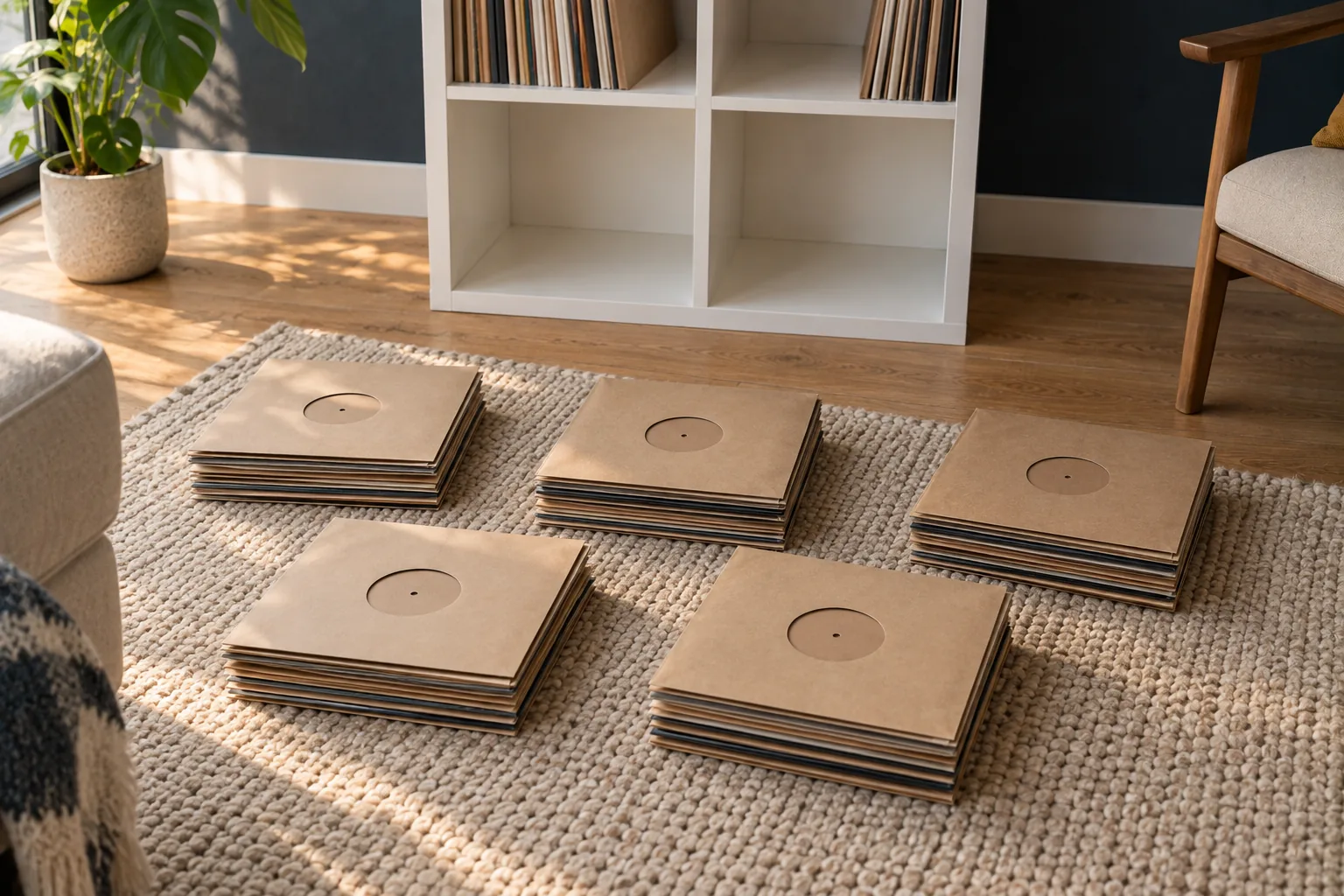
Take everything out of the cabinet and lay it on the floor in rough piles, for alphabetical say A to E, F to K and so on. Only when every record is in a pile do you sort within the piles. That is faster than trying to put each one in the right place straight away, and it keeps the mess manageable if you have to stop halfway.
Then put them back with room to spare. A compartment that is completely full forces you to shift everything along at the next purchase, and that is the job people put off. Keep about five centimetres free per compartment, and divide the compartments so the growth fits: for almost everyone the letter S is bigger than the letter Q.
Finally, put on music that plays for a long time and does not need changing, or you will spend the whole afternoon breaking your own order.
Add a row that has no system
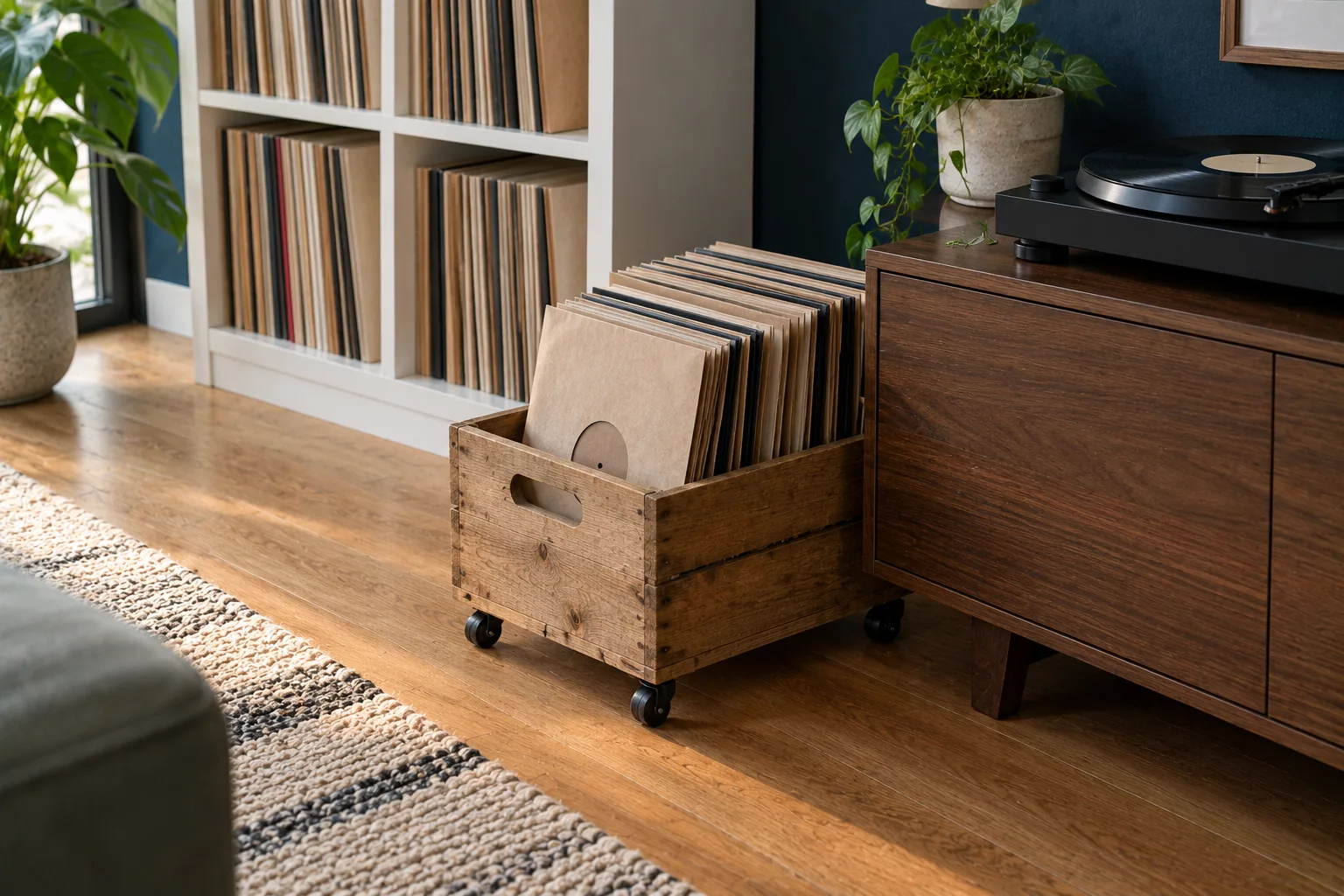
The thing that keeps an order standing for years is the place where the order does not apply. A crate or a compartment by the turntable for what you are playing these weeks, twenty records at most, in no order. That is where the record you just played goes, and not back into the cabinet.
It sounds like the road to chaos and it is the opposite. Putting records back is the step every system trips over, because you have to do it at the moment you are actually done listening. With a crate you move that step to one moment a week, when you put twenty records back in one go, and then the cabinet is right again.
Which kind of crate works for that, and why it needs to be tall enough to keep the records upright, is covered in the guide on buying a record cabinet.
Do the maintenance while you have them in your hands
An organising afternoon is the only moment when you hold every record once, and that is too valuable to spend only on order. Move records that are still in an old, dusty paper inner sleeve into a clean anti-static sleeve. That is the biggest improvement per euro there is for a collection, and you are opening them anyway.
Look at the record itself at the same time. If you see a dull haze or feel dirt, put it to one side on a little pile for later rather than washing it straight away; otherwise you will still be at it at four o'clock and the order will not be finished. How to tackle that pile afterwards is covered in the guide on cleaning records.
Outer sleeves are the targeted purchase here. It is when you organise that records get handled and moved about, and that is where sleeves wear, not when you play them. An outer sleeve takes that wear and keeps the original cover underneath intact. How the records then stand in the room without it becoming a warehouse is covered in the guide on storing records.
Keeping track of what you have
With a hundred records you do not need a catalogue, and anyone who says you do is usually selling one. What you do need is something you can check in the shop, because the only real cost of having no overview is duplicate purchases and the record you do not buy because you are not sure whether you already have it.
The thirty-second version: take a photo of each shelf with your phone, straight on, and keep them in an album. You can read the spines, you always have it with you, and you only need to renew it after an organising afternoon. For most collections of this size that is enough.
If you want more, keep a simple list of artist, title and the year you bought it. A wish list beside it is at least as useful: it is what you hand to someone who wants to give you a record, and it saves them the guesswork described in the guide on giving vinyl as a gift.
When the system really has to change
At around two to three hundred records, purely alphabetical often gets awkward, simply because a single letter then fills a whole shelf. That is the natural moment to add a second layer, for example artist within genre. Not earlier: building a system ahead of a collection you do not have yet is the mistake most people make, and they drop it again within a few weeks.
There are three signs that your order is no longer working, and none of them is the number of records. A pile is growing on top of the cabinet. You search for more than half a minute for a record you know you have. And you accidentally buy something twice. If you see two of the three, it is worth an afternoon's work.
The honest conclusion is that being consistent counts for more than being clever. A simple system you really apply every time keeps a collection clear. A cunning system that fades after the third new record gives you exactly the same messy pile as no system at all.
What it costs
Organising itself costs nothing, which is the nice thing about it. What you might buy alongside is small: anti-static inner sleeves cost around ten to fifteen euros per fifty, outer sleeves about the same, and a set of card divider tabs to separate the letters a few tens of euros, or nothing if you cut them from stiff card.
A crate next to the turntable costs a few tens of euros and is the purchase that does the most, because it keeps the order in place rather than making it prettier. With a hundred records that is the whole shopping list; anything beyond it is a solution for a collection you do not have yet.
Frequently asked questions
- How do you organise a record collection of about a hundred records?
- Alphabetical by artist name is usually enough at that size: one decision per record and you find everything within seconds. Chronological by date of purchase works too, because then there is nothing to decide. Most people start sorting by genre too early; it only pays off from a few hundred records and with four or five categories at most.
- Do you put The Beatles under B or under T?
- Under B. The usual choice is to ignore the article, as libraries do, and the same goes for The Rolling Stones and similar names. More important than which choice you make is that you make it once and write it down, together with what you do with solo records, compilations, soundtracks and classical.
- Where do compilations and soundtracks go?
- Give them a compartment of their own at the end. Anything with several artists has no logical place in an alphabet by artist name, and nobody looks under V for Various. Classical goes by composer rather than by orchestra or conductor, because that is how you remember it yourself.
- When should you reorganise your collection?
- Not at a number, but on signs. A pile grows on top of the cabinet, you search for more than half a minute for something you know you have, or you accidentally buy a duplicate. With two of those three, it is worth an afternoon. At around two to three hundred records, a second layer such as artist within genre is a logical step.