
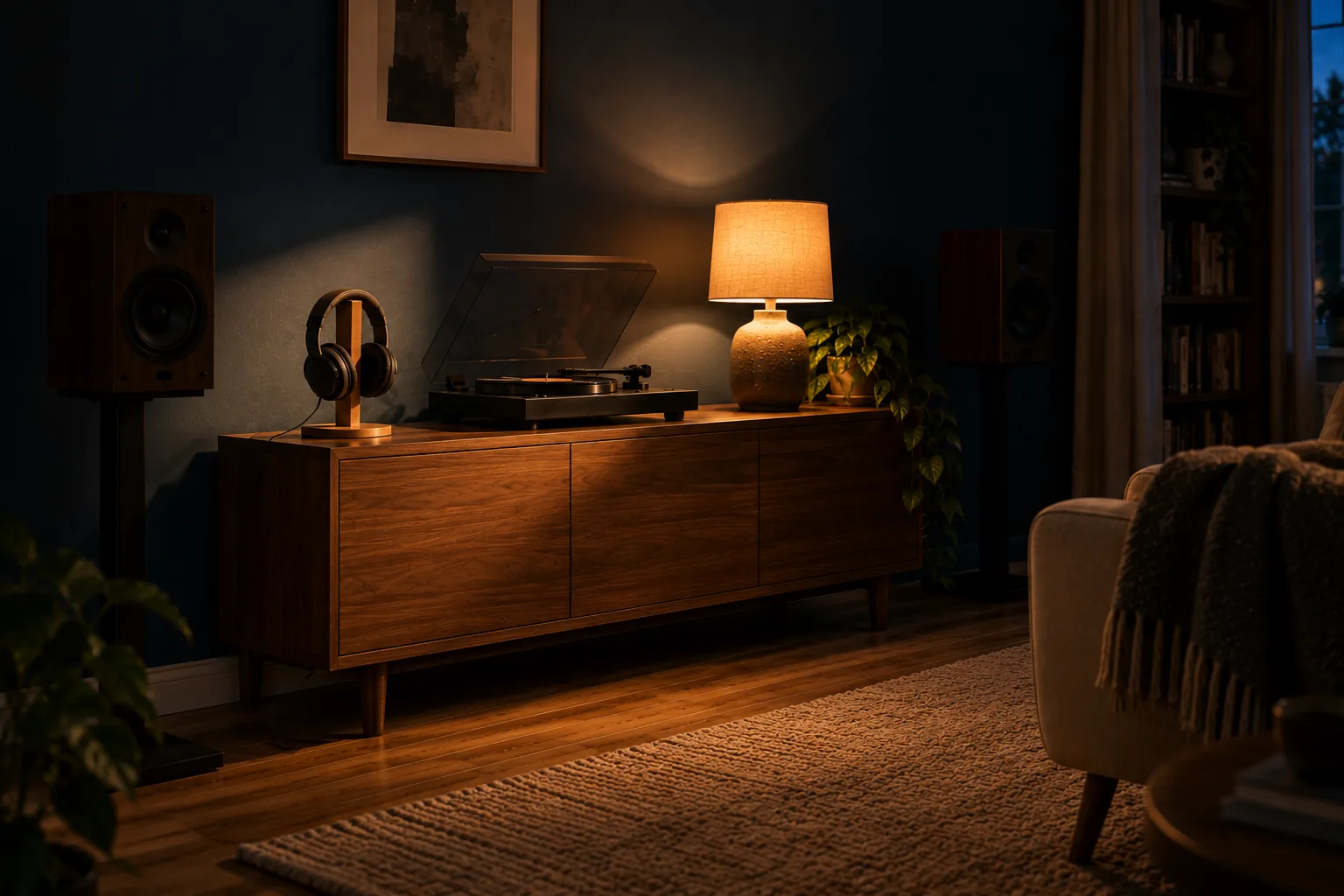
The problem: You want to listen with attention, but you cannot always turn the speakers on, or do not want to.
The short route: Choose open or closed for your home and your head, not from a spec sheet, and sort out what you plug them into first.
A turntable has no headphone socket
This is the first thing people run into and it is hardly mentioned anywhere: almost no turntable has a headphone output. The signal that comes out is a phono signal, a hundred times quieter than what headphones need and not yet corrected either. So plugging headphones straight into a turntable does not give you quiet sound, it gives you almost nothing.
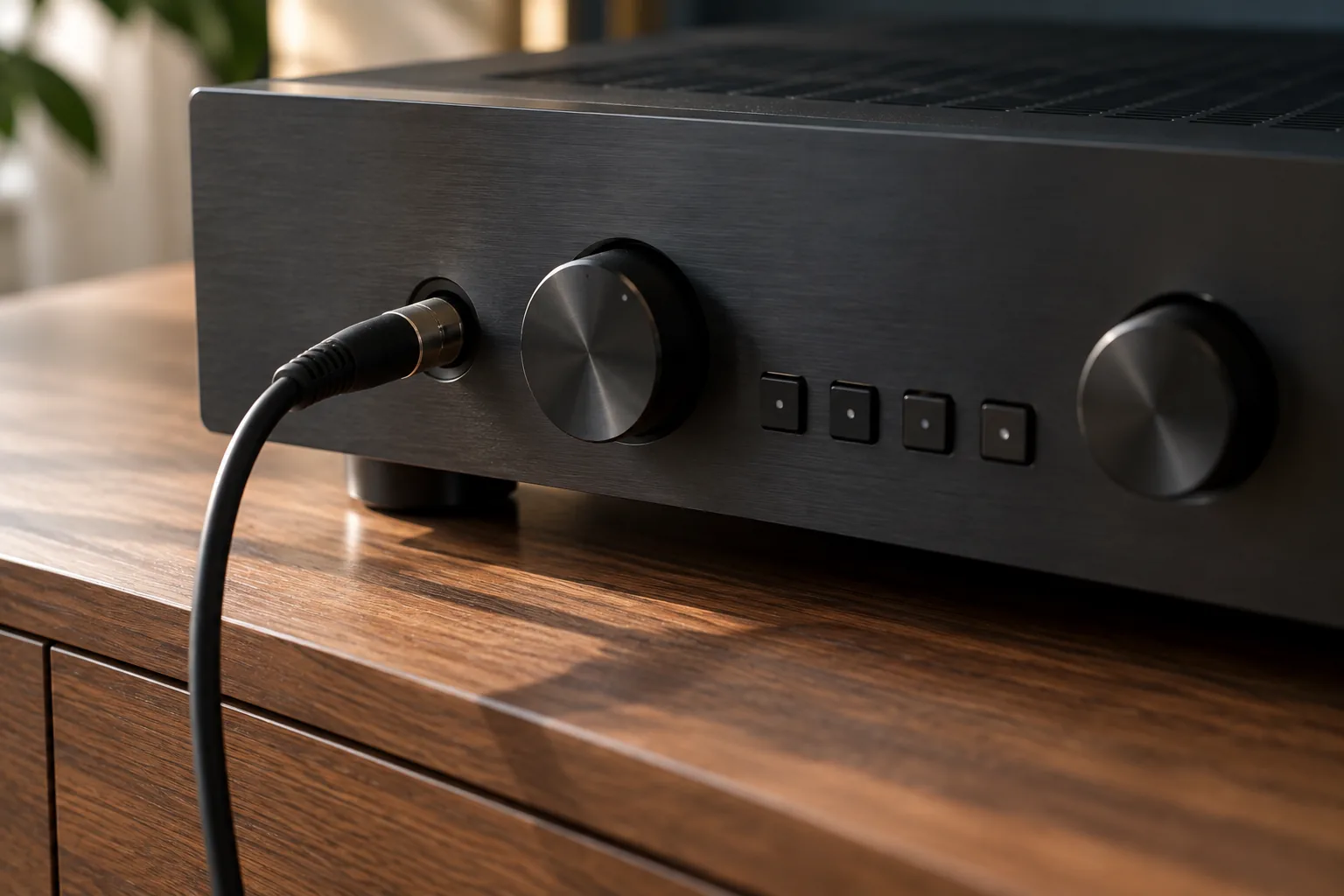
There are three routes that do work. The most common: your amplifier has a headphone output on the front, usually a 6.3 millimetre jack, and that is where you plug in. The second: you do not have an amplifier but you do have active speakers, and some of those have their own headphone socket on the back or the side. The third: a small separate box between the turntable and the headphones that does both the phono correction and the amplification.
Which route you have depends on what is already there. If you have not chosen an amplifier yet, include the headphone output in that choice; it is a socket you cannot add later. How the rest of that chain fits together, and what a phono preamp actually does, is covered in the guide on connecting your turntable.
Mind the jack size. Many home amplifiers have the big 6.3 millimetre output, while many headphones have a cable with a small 3.5 millimetre plug and a loose adapter. You will lose that adapter. Buy a second one straight away, or choose headphones with a detachable cable and keep the right one by the cabinet.
Open or closed is a choice about your home
Open-back headphones have a grille instead of a sealed cup. That makes them sound more spacious and less like a box around your head, and they get less warm after an hour. The price is that sound leaks both ways: you hear the room and the room hears you. From half a metre away that is audible as a faint hissing tune.
Closed-back headphones block out the world and keep the sound in. In a house where someone else is watching TV, on a train, or next to a sleeping child, that is the difference between listening and not listening. They sit warmer, usually press a little firmer and sound a bit more direct, as if the sound is closer to your ears.
The practical rule of thumb: if you mostly listen alone in a quiet room, open is more pleasant and the leak is no problem. If you share the room or the hour with someone else, closed is the choice you will actually use. If in doubt, choose closed, because open headphones only half solve the problem you bought them for.
Noise cancelling is a third category and belongs with travel, not with a turntable at home. The technology adds its own background, and you are in your own room anyway. For the evenings this guide is about, the same money buys you better ordinary closed headphones.
Comfort is the only spec that still counts after twenty minutes
An album lasts forty minutes. Every pair of headphones sounds good for the first five, and the difference is in what happens at minute thirty. Clamping force, weight and the material of the pads decide whether you finish the record or take them off halfway through, and none of those three is on the box.
Watch the weight. Under 300 grams you barely notice headphones; above that the headband starts to matter, and then the padding on it has to be good. Watch the pads too: velour breathes and stays cooler, faux leather seals better and gets sweatier. Faux leather is also the part that starts flaking first, usually after about three years.
If you wear glasses, clamping force is the most important number nobody mentions. A firm clamp presses the arm of your glasses into your temple, and after half an hour that hurts. Softer pads and a slightly looser band then matter more than any difference in sound.
So test for twenty minutes, not two. Put them on, do something else and notice whether you start thinking about them. The headphones you forget about are the right ones.
What they need to play on
Two numbers decide whether headphones suit what you have: sensitivity, in decibels per milliwatt, and impedance, in ohms. Use them to check whether something fits, not to read off quality. An expensive pair of 250 ohm headphones on a laptop is quieter and limper than a cheap 32 ohm pair on the same device.
The practical version: most headphones up to about 100 ohms play perfectly well from the headphone output of an ordinary home amplifier, and from a phone with the right adapter too. Above that it is case by case. Whether you need a separate headphone amplifier is a story in itself, with more nuance than fits here, and it will get a guide of its own.
Either way, start with what you have. If it sounds clear and relaxed on your amplifier, the chain is finished. Only if it sounds quiet and lifeless with the volume knob already turned well up is there a reason to look further.
The cable and where you sit
Headphones are tied to the amplifier, and the amplifier is against the wall. That is why people with good headphones still end up standing at the cabinet instead of sitting down. Measure the distance from the cabinet to your chair before you choose: the standard is 1.2 or 3 metres, and 1.2 metres is almost always too short for a listening chair.
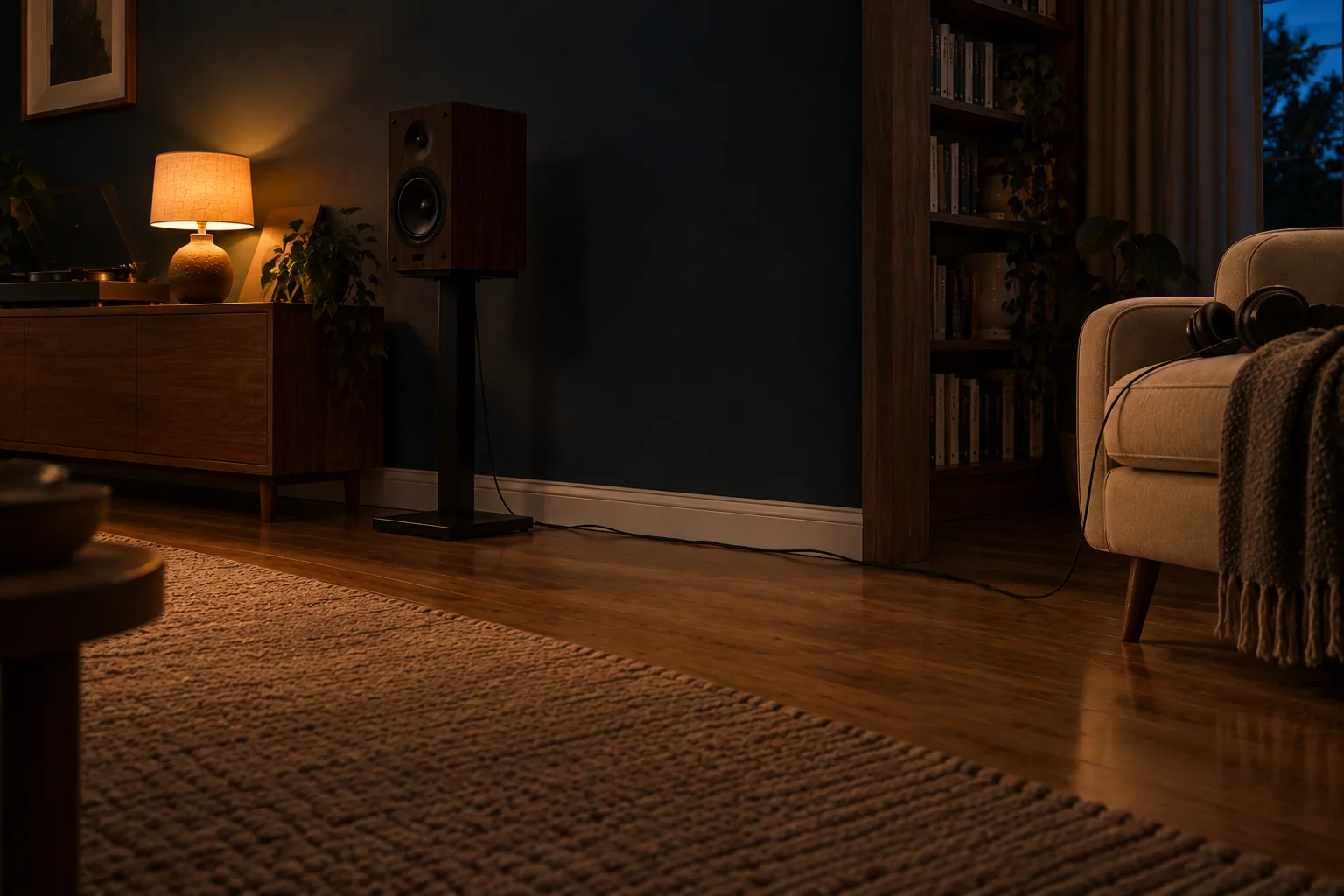
An extension cable solves that for a few tens of euros, but do not run it across the walkway. Headphones hanging from a cable across the floor get yanked one day, and then it is the socket in the amplifier that gives way. Along the skirting board and behind the cabinet looks worse and lasts for years.
Preferably choose a model with a detachable cable. The cable is the part that breaks, usually close to the plug, and with a fixed cable that is the end of the headphones. With a detachable one it is a twenty-euro order. Hang them on a hook or a stand by the cabinet as well: over a door handle or round the corner of the cabinet they stretch.
Wireless and vinyl
Wireless works, but not out of the box. A turntable does not transmit Bluetooth, so either a transmitter has to hang off your amplifier or the turntable must have one built in. The signal is then sent compressed, and with that some of the detail you were looking for on the record goes.
That is not a disaster and not a dogma. For the record playing in the background while you cook, wireless is exactly right and the freedom is worth more than the difference. For the album you sit down for, a cable is more honest and cheaper, and it has no battery to run out on side two.
If you want wireless anyway: choose a model that also works with a cable. Then it is one pair of headphones for two kinds of evening instead of two purchases.
Set the volume lower than your first instinct
With headphones the source is on your ears, and that changes two things. You hear details that disappear in the room with speakers, and you notice sooner when a recording is loud or tiring. The temptation is then to turn it up to get through it, which works exactly the wrong way.
Turn it down a little further than your first instinct and give it two tracks. Almost always you hear more afterwards, because you are no longer listening against the harshness. A practical limit: if you can still make out that someone next to you is speaking at a normal voice, you are fine for a long evening.
That is not only about enjoyment. Headphones can play louder than you think for hours on end, and hearing damage does not come from one loud evening but from many ordinary evenings just a bit too loud. Making it a habit costs nothing.
What it costs
Between eighty and a hundred and fifty euros is the category where headphones are genuinely better for the first time than what came with your phone: decent pads, a neutral tuning and usually a detachable cable. For most listeners that is also the category they stay in.
Between a hundred and fifty and three hundred euros you mainly buy comfort and build quality: lighter construction, better headbands, parts you can reorder. The difference in sound from the tier below is there, but it is smaller than the price difference suggests, and smaller than the difference a better connection makes.
Above that begins the territory where you are buying taste and the rest of the chain starts to count. That is a fine place to end up, but not a place to start. For a first pair, keep twenty euros back for a spare cable and a stand rather than spending a hundred more on the next model up.
A second setup, not a stopgap
Headphones only become something once they have a fixed place. On a hook beside the cabinet, with the cable already in the amplifier, they are on your head within ten seconds. In a drawer at the bottom of the cabinet they are there for guests. That difference decides whether you use them twice a week or twice a year.
Use them for something other than the speakers, too. Albums you have heard a hundred times sound new on headphones because you hear the background; live recordings and anything with a lot of space in it gain the most. That way it becomes a way of listening of its own rather than the version where you are missing something.
And it solves the problem most listening corners founder on: the hours when it has to stay quiet are usually exactly the hours when you have time. What the rest of that corner looks like is covered in the guide on setting up a listening corner, and what to do with that late hour in the guide on the listening evening.
Frequently asked questions
- Can you connect headphones directly to a turntable?
- Almost never, because hardly any turntable has a headphone output. The signal from a turntable is a phono signal: far too quiet and not yet corrected. You connect headphones to the headphone output of your amplifier, to active speakers that have one, or to a separate box that does the phono correction and the amplification together.
- Open or closed headphones: which is better at home?
- That depends on your home, not on quality. Open sounds more spacious and stays cooler, but leaks sound in both directions, so it only works if you sit alone in a quiet room. Closed keeps the sound in and the room out, and is the right choice as soon as you share the space or the hour with someone.
- How long should the headphone cable be?
- Measure the distance from the amplifier to your chair. Standard cables are 1.2 or 3 metres, and in practice 1.2 metres does not reach your listening chair. An extension costs a few tens of euros; run it along the skirting board and not through the walkway, because a cable that gets yanked damages the socket in the amplifier.
- Are wireless headphones suitable for vinyl?
- Fine for background listening, less so for an album you sit down for. A turntable does not transmit Bluetooth itself, so a transmitter has to hang off the amplifier, and the signal is sent compressed. If you want wireless anyway, choose a model that also works with a cable.