
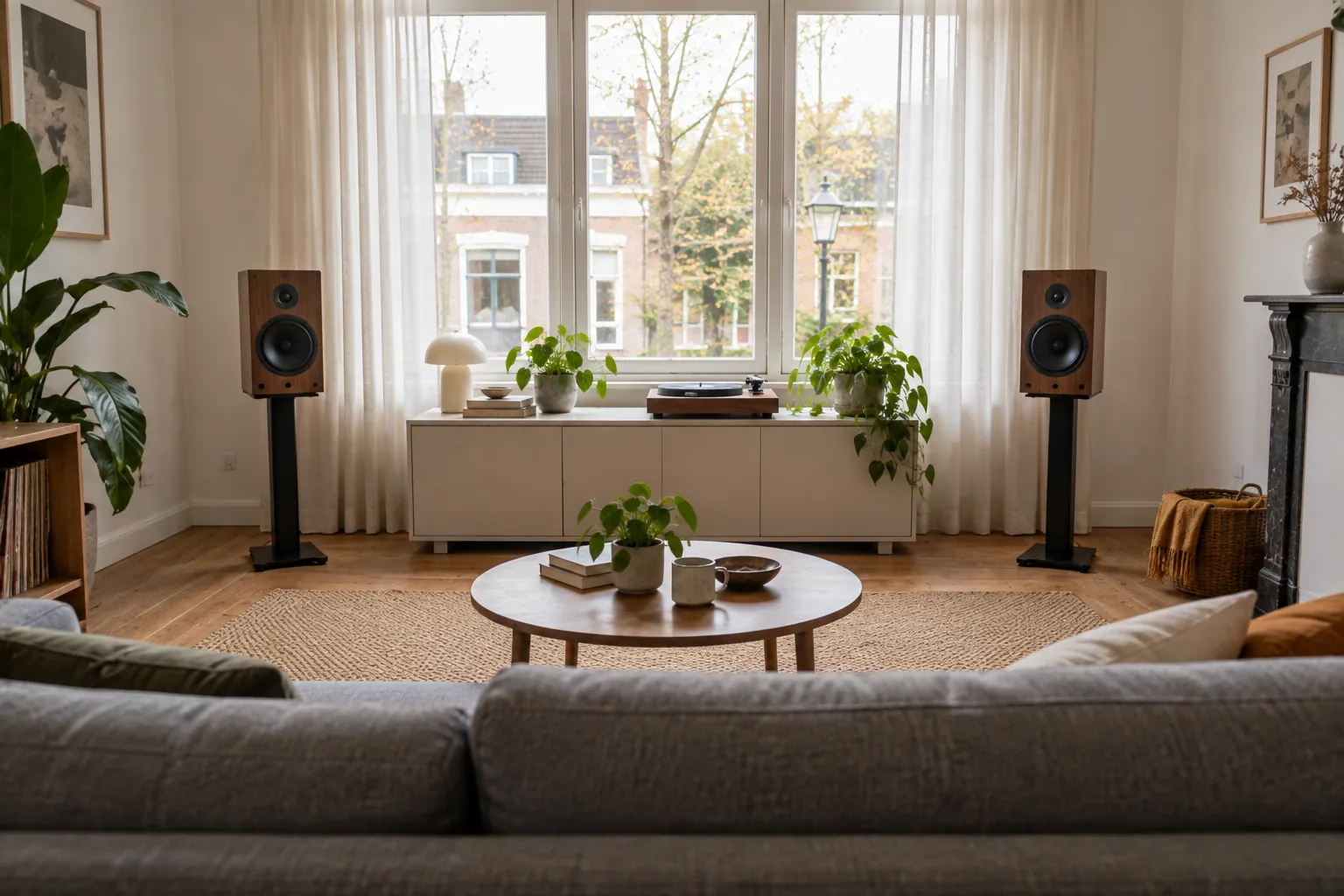
The problem: You want better sound, but your room is not an empty listening space and your neighbours can hear it too.
The short route: Choose a size the room can handle and put your attention into placement.
The room has a say
In a compact living room, distance counts for more than size. Bookshelf speakers on stands sound surprisingly grown-up as long as they stand free and are not pushed into a cabinet. Floorstanders need more air around them and only make sense if you really have that space.
Roughly measure your listening distance. If you sit two metres from the speakers, you rarely need an enormous pair. A speaker that stays clear at low volume suits how you will use it day to day.
The typical living room has a few fixed features: a radiator under the window, a sofa against the long wall, a wooden or laminate floor and neighbours on at least one side. A speaker that sounds good there is one that can stand close to a wall without the bass booming, and that still lets you hear detail at the volume you actually listen at in the evening.
Bookshelf or floorstanding
A bookshelf speaker is a box thirty to forty centimetres tall with a tweeter and a woofer of twelve to seventeen centimetres. On a stand at ear height it does everything a living room asks of it, apart from the deepest bass. A floorstander is the same speaker in a bigger box, often with a second woofer underneath: more bass, more volume without effort, and more room needed to breathe.
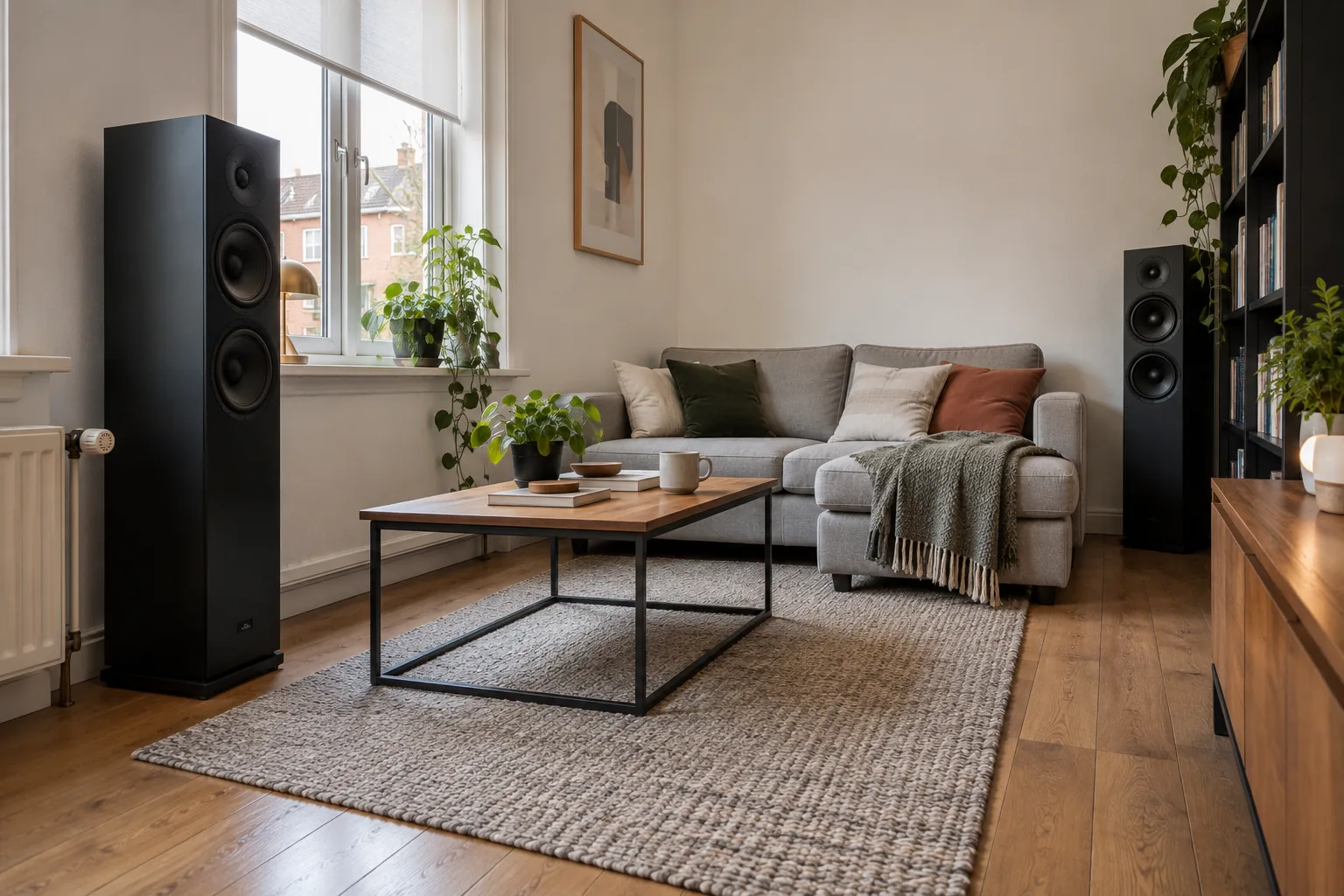
That bigger box is exactly the problem in a small room. Bass needs distance to unfold; if a floorstander stands thirty centimetres from the wall and two metres from your ears, you hear the room more than the speaker. A bookshelf speaker on a stand gives a tighter, clearer picture at those distances, and you rarely hear the deep bass you are missing at living room volume.
Floorstanders belong in a room where they can stand a metre from the wall, three metres or more from the listening spot, and where nobody lives below you. If you have that room, they are the logical choice. If in doubt, the smaller speaker on a good stand almost always beats the bigger one in a corner.
Active or passive
Active speakers have the amplification built in and keep your setup tidy. That is handy if you want a turntable, a streamer and a television to run through one route. Passive speakers give you more choice later, but they need a matching amplifier and extra cables.
Neither is more serious than the other. Just count how many devices you really use and choose on that basis.
With active speakers, watch two things. First, the inputs: a turntable without a built-in preamp needs a phono input, and far from every active speaker has one. Second, the cable between the two speakers: on most pairs the amplifier sits in one box with a cable running to the other, so you need a socket on one side and a cable across the floor. With passive speakers you choose the amplifier separately, and that is also where you can take the biggest step later without replacing the speakers.
Placement does more than the price tag
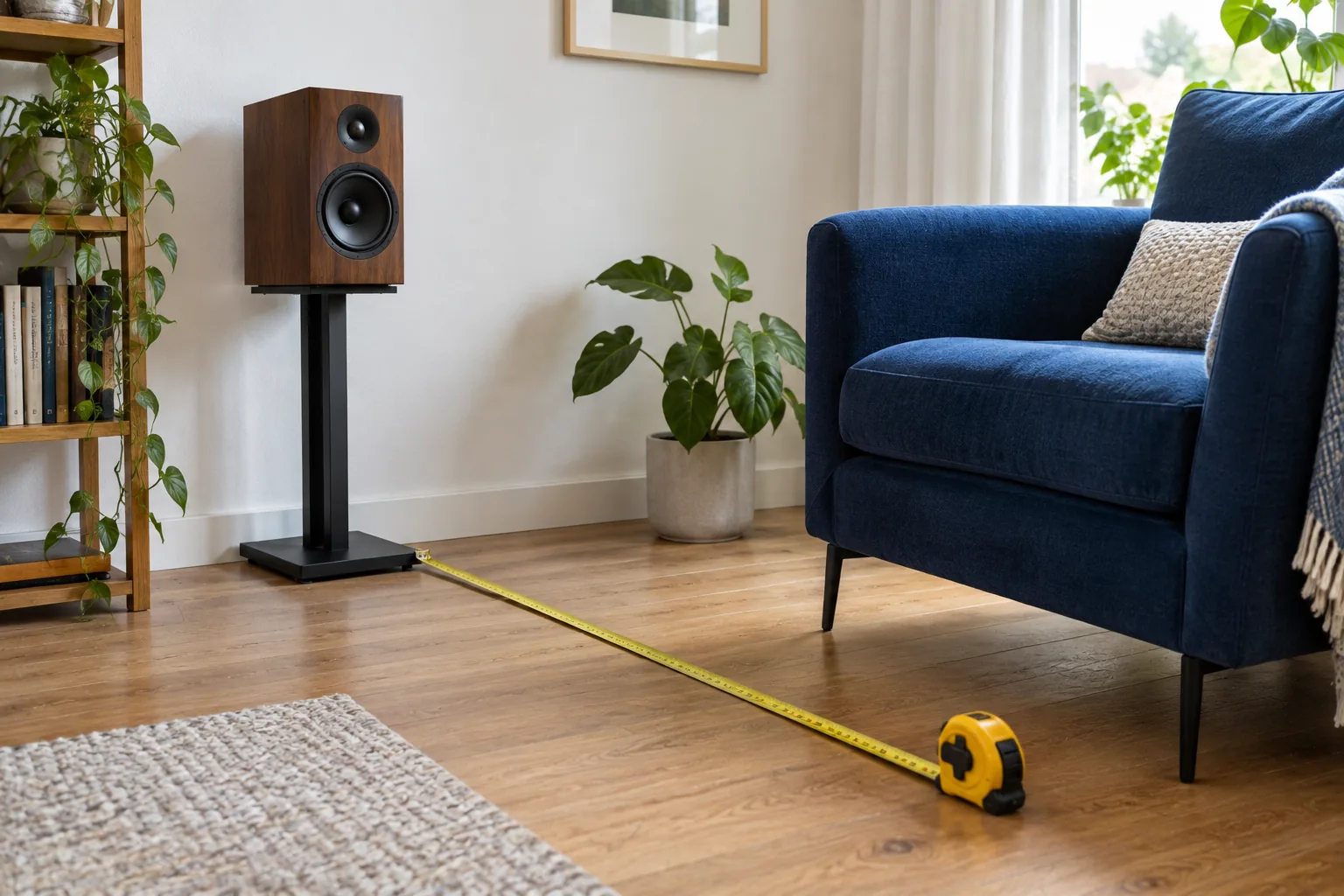
Three rules decide most of it. Put the tweeters at ear height when you are sitting, so about a metre above the floor; a speaker on the floor or in a cabinet sounds dull whatever you paid for it. Keep the distance between the speakers roughly equal to the distance from the speakers to your listening spot, so you get a triangle. And angle them in slightly, so they cross just in front of or just behind your head.
Distance from the wall is the knob for the bass. Close to the wall the bass gets fuller and muddier, further away tighter and leaner. Start at thirty centimetres and move ten centimetres at a time, with a record you know well. A corner is the worst place there is, because two walls boost the bass at once.
Stands do not have to be expensive, but they do have to be heavy and solid. A speaker on a wobbly shelf sounds restless because the box itself moves. A filled stand, or a heavy cabinet that does not give, is the cheapest improvement you can make to a setup.
Neighbours and volume
What goes through the wall is almost always bass. Voices and guitars stay in your room; the lowest notes do not. If you live in a terraced house or a flat, you get more out of a speaker that stays clear at low volume than out of one with lots of bass, and more out of placing it away from the shared wall than out of a thick mat.
Some active speakers and many amplifiers have a setting that cuts the bass below a certain frequency, often meant for a subwoofer. For late evenings it works fine the other way round: switch it on and the neighbours hear less while you barely miss anything. And for evenings when the speakers really have to stay off, there are headphones, which have a guide of their own.
What to expect at each price
Between two and four hundred euros a pair buys a bookshelf speaker that renders voices and guitars convincingly and does not tire you at living room volume. That is the class where most people stay happy, especially on a good stand. Between four and eight hundred euros you get a better tweeter, a sturdier box and a speaker that stays calm at higher volume; you mainly hear the difference in space and detail. Above that you pay for finish and the last bit of bass and precision, and the amplifier and the room decide whether you hear that difference.
With active speakers the amplifier is in the price, so compare a six-hundred-euro active pair with a three-hundred-euro passive pair plus a three-hundred-euro amplifier, not with a six-hundred-euro passive pair. Prices shift; the proportions do not.
Listen to voices, not bass
In a short demo, deep bass grabs your attention straight away. At home, voices, guitars and piano turn out to matter more. So bring music with a calm voice, a full band and a recording you know well. Notice whether you want to keep sitting there, not whether the first thirty seconds impress.
If you are unsure, buy from a shop with a clear returns policy and plan a quiet evening at home. The speaker you are looking for does not stand out.
At home, listen at the volume you normally listen at, not louder. A speaker that impressed in the shop at high volume and sounds flat at home at low volume is the wrong one; the opposite speaker is the right one.
Frequently asked questions
- Which speakers or loudspeakers suit a small living room?
- Bookshelf speakers on solid stands. They need less distance from the wall than floorstanders, sound clearer at living room volume and keep the bass under control. Put the tweeters at ear height and keep thirty to fifty centimetres from the wall.
- How far apart should speakers be?
- About as far apart as the distance from the speakers to your listening spot, so you get an equilateral triangle. If you sit two metres from the speakers, place them about two metres apart and angle them in slightly. After that, only adjust the distance from the wall.
- Are active speakers better than passive ones?
- Neither is better. Active speakers have the amplifier built in and are more compact and simpler; passive speakers need a separate amplifier but let you upgrade it separately later. With active speakers, check that the inputs suit your turntable, streamer or television.
- How much should you spend on speakers?
- Between two and four hundred euros a pair buys bookshelf speakers most people are happy with for years. More money mainly buys calm at higher volume and more detail; whether you hear that depends on the room, the placement and the amplifier. With active speakers, include the amplifier in the comparison.