
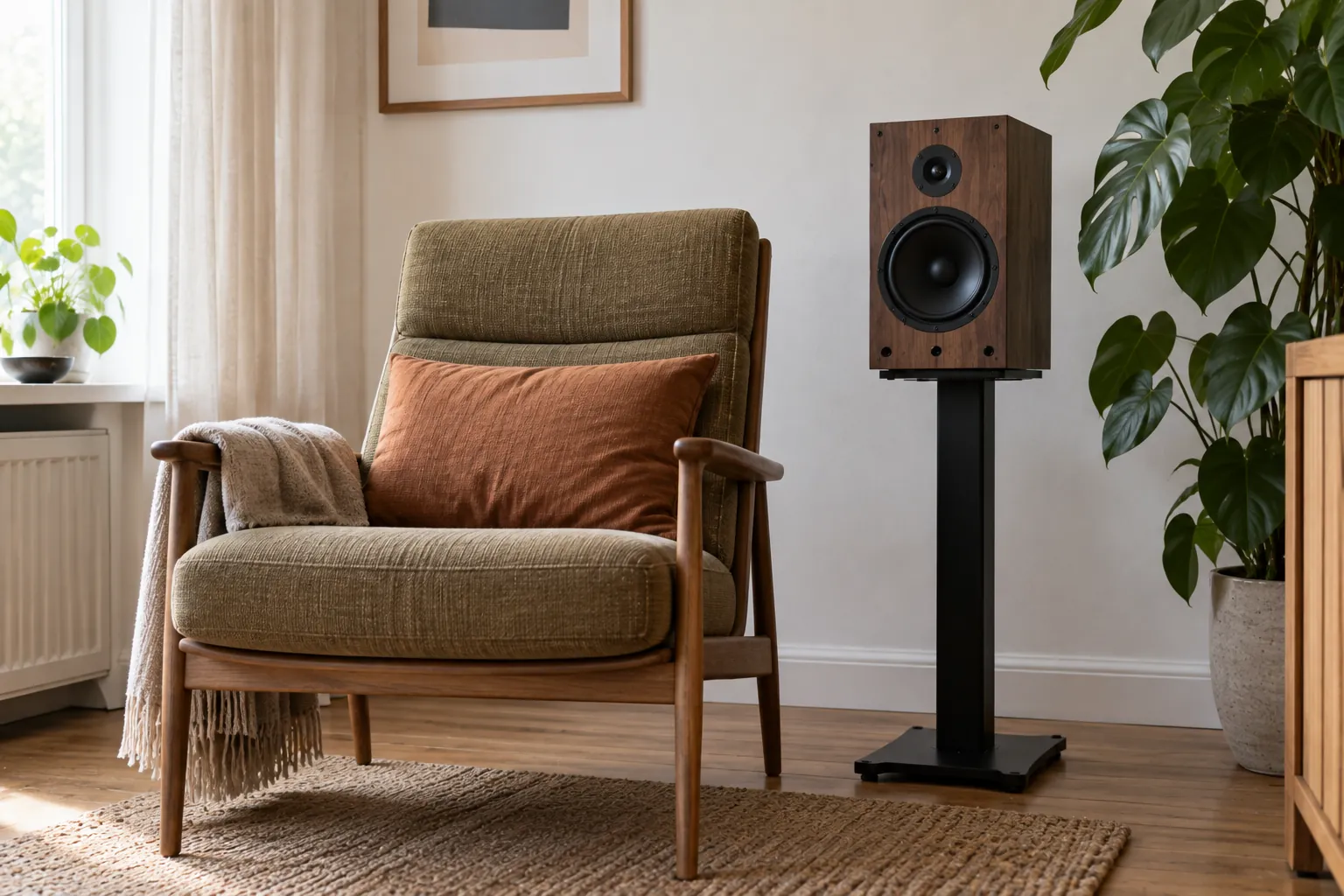
The problem: Your room seems too small for good speakers: the sofa is against the wall, the speakers are wherever there was space, and the bass booms or disappears.
The short route: Take the speakers out of the corner, put the tweeters at ear height, make a triangle and move the sofa off the wall, before you buy anything at all.
Placing speakers in a small room is not a lost cause
Anyone placing speakers in a small room often starts from the idea that it will never sound good. That is not true. A small room has a few real drawbacks, especially in the bass, but also one big advantage: you sit close to the speakers. The closer you sit, the more you hear the speaker and the less the room. A pair of bookshelf speakers one and a half to two metres from your ears can sound more precise in a three-by-four-metre room than the same pair in a big, empty living room.
What goes wrong in a small room is almost always the placement, not the speaker. The speakers are in the corner because there was space there, on the cabinet because there is a socket, and the sofa has its back to the wall because that is how it is in every living room. Each of those three choices costs sound, and none of them costs money to change.
This guide is about that placement: distance from the wall, the height of the tweeter, the triangle between you and the speakers, and where the sofa goes. Which speakers suit a small room is covered in the guide on choosing speakers for a living room. Here we start from the speakers you already have.
Out of the corner first, and away from the wall
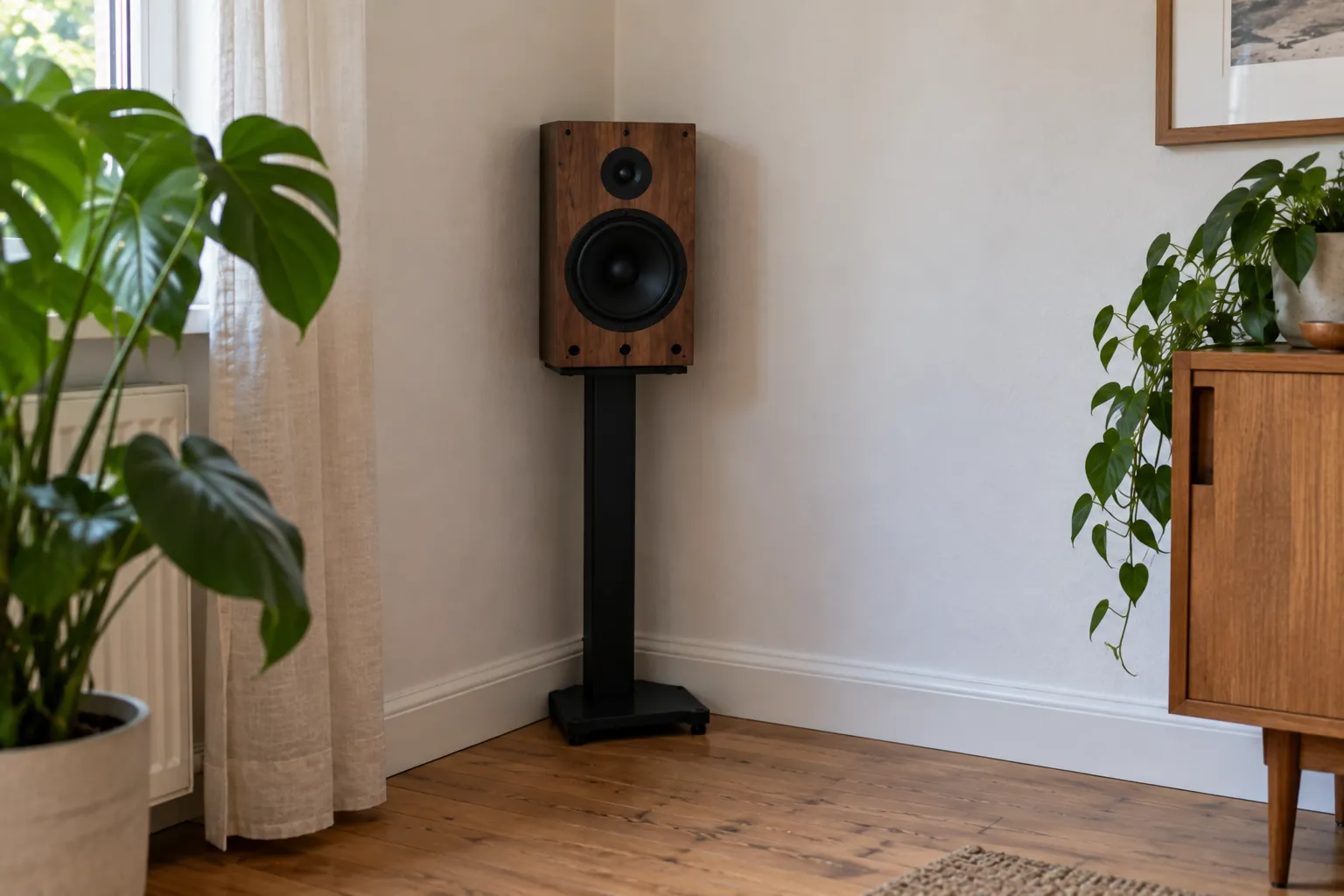
The corner is the worst place in the room. Every wall close behind or beside a speaker reflects the low notes back and boosts them, and in a corner that happens from two walls at once, plus the floor. The result is bass that sounds fat, slow and muddy, with some notes booming and others dropping out. However good the speaker is, in the corner it sounds like a cheaper one.
So start with the speakers thirty to fifty centimetres from the back wall, and at least as far from the side wall. In a narrow room that is not always possible on both sides. Then at least make sure the distance to the side wall is about the same left and right, so the bass behaves the same on both sides. If one speaker stands next to a wall and the other next to an open door, one side sounds fuller than the other and the sound shifts towards it.
Look at the back of the speaker as well. A speaker with a hole in the back, a bass reflex port, blows air backwards and reacts more strongly to the wall than a speaker with the port at the front or no port at all. Many of those speakers come with a foam plug in the box to close the port. If the speaker has to stand close to the wall and it booms, try that plug: you give up a little deep bass and get tighter bass back.
After that, distance from the wall is the knob you use to adjust the bass. Move ten centimetres at a time and listen to the same record each time. Closer to the wall the bass gets fuller, further away tighter and lighter. Somewhere in between is the point where a track's bass line sounds even, with no notes jumping out.
The tweeter at ear height
The tweeter is the small driver at the top of the box, and it decides how clear and precise the sound is. High notes go into the room far more directionally than low ones. If the tweeter points at your chest, your knees or over your head, you hear a duller sound than the speaker can make. So the rule is simple: the tweeter belongs at the height of your ears when you are sitting, for most chairs and sofas about ninety to a hundred and ten centimetres above the floor.
A bookshelf speaker on the floor, low on a TV unit or high on a bookcase misses that point by a long way. On the floor you mainly hear bass and the reflection off the floor; on a high cabinet it sounds thin and the music seems to come from above. A stand of sixty to seventy centimetres brings most bookshelf speakers to the right height, and it is also the way to get them away from the wall and out of the corner. A stand does not have to be expensive, but it does have to be heavy and solid: a speaker that moves on a wobbly base sounds restless.
If there is no room for stands and the speakers have to go on a cabinet or sideboard, two things help. Line the front of the speaker up with the front edge of the cabinet, so the top does not act as a mirror for the tweeter. And tilt the speaker slightly towards your ears if it stands lower than ear height. There are small tilting stands and foam pads for that, which also decouple the speaker from the top so the cabinet vibrates less. They do not turn a sideboard into a stand, but they fix the biggest problem of the place where the speaker had to go anyway.
The triangle: smaller is fine
The distance between the two speakers should be about the same as the distance from each speaker to your head. Then you and the speakers form an equilateral triangle, and that is where the stereo image is: the singer in the middle, the instruments to the left and right of them, even where there is no speaker. In a small room that triangle is simply smaller. One and a half metres on each side is not a stopgap; at that distance you hear more of the speaker and less of the walls.
Then angle the speakers in slightly, so they point just at or just beside your ears. Exactly how much differs per speaker and per room. A simple check is a recording with a voice dead centre. If that voice sounds as if it floats between the speakers, it is right. If it comes from one speaker, you are not sitting in the middle or one speaker is further away than the other. Check it with a tape measure, because the eye is easily twenty centimetres out.
If an equilateral triangle is not possible because the wall is too narrow or there is a window, put the speakers closer together rather than further apart. Too far apart leaves a hole in the middle, where the singer suddenly seems to come from far away. Slightly too close only makes the image a little narrower, and you notice that far less.
Move the sofa
The most valuable advice in this guide is free: move the sofa. In almost every living room the sofa has its back to the wall. For a listening position that is the most awkward place, for the same reason the corner is for a speaker. Right in front of a wall the bass piles up, and your head is right in that pile. The music then sounds heavy and muddy, and you turn it down when it is really the position.
Pull the sofa thirty to fifty centimetres away from the wall, or move it some way forward into the room, and listen again. Often that is the biggest improvement you can make in a small room. The space behind the sofa does not have to stay empty: a low cabinet or a plant fits there fine, as long as your head is no longer resting against the wall.
Also do not sit exactly in the middle of the room, measured from the speaker wall to the back wall. At that point some low notes cancel each other out, and the bass drops away while the speakers are still playing it. A usable starting point is about forty percent of the room's length, measured from the wall behind you or from the wall behind the speakers. Move from there in steps of ten centimetres, with a track that has an even bass line, until no single note stands out any more.
If it cannot become a real listening spot because the room also has to stay a living room, that is no problem. Choose the place where you usually sit and aim the triangle at it. How to set up such a spot with a chair, a lamp and a surface for the turntable is covered in the guide on setting up a listening corner.
Hard walls, windows and a bare floor
Apart from the bass, a small room suffers from reflections: the sound that reaches you via the side wall, the window or the floor a fraction later than the sound from the speaker. A little of that makes the sound lively. A lot of it, in a room with bare walls, a big pane of glass and a laminate floor, makes it hard and tiring, especially as the volume goes up.
You find the spots that matter most with a mirror. Sit in your listening position and have someone hold a mirror flat against the side wall and slide it along. Where you can see the speaker in the mirror from your chair, sound bounces towards you. That is where something soft does the most work: a curtain, a full bookcase, a wall hanging. On the floor between you and the speakers, a rug does the same for the floor reflection.
Do not expect miracles from fabric in the bass. Curtains, cushions and rugs damp high and mid frequencies, not the low notes that boom. Bass is solved with distance: from the wall, from the corner and from the wall behind you. Whatever soft furnishings you have at home are enough for the reflections; special acoustic panels are rarely needed in a living room.
What does not belong on the same cabinet
If the speakers and the turntable are on the same sideboard, the top vibrates along with the bass, and the turntable picks up that vibration. The stylus then reads not only the groove but the cabinet too. At low volume you hear that as vaguer bass; at higher volume as a booming feedback tone that swells until you lift the stylus. So put the speakers on stands or a different piece of furniture from the turntable, or at least decouple them with pads. Why the surface under the turntable itself matters is covered in the guide on buying a turntable.
A full record cabinet is a sturdy piece of furniture, but not a good speaker stand: the top is usually too low for the tweeter, and a speaker on the cabinet vibrates along with everything inside it. If the speakers really cannot go anywhere else, put them as far from the turntable as possible, at the outer edge of the top, on pads.
In a small room, cables are often the reason a speaker stays in a bad spot: the lead is just too short. A longer speaker cable costs little and is no compromise on sound at living room distances. How the rest of the setup connects together is covered in the guide on connecting your turntable.
Move things in this order, and only buy afterwards
Work from big to small and change one thing at a time. First the speakers out of the corner and off the wall. Then the height, so the tweeters are at ear height. Then the triangle and the angle inwards. Then the sofa off the wall and the listening position out of the middle of the room. Only then the reflections, with what you already have at home. At every step use the same two or three tracks you know well: a calm voice, a track with an even bass line and a full recording.
What you still miss after that is usually height or stability, and that is the moment to buy something: stands if the speakers are too low on a cabinet, or tilting pads if a cabinet really is the only place. Those are the two purchases that go with this guide, and they come after the moving, not before. Buy new speakers straight away for a room where the old ones stood in the corner, and you simply get the same problem delivered again.
If the bass still goes through the wall to the neighbours after the moving, a speaker further from the shared wall helps more than any cushion. And for evenings when it really has to be quiet, there is the guide on headphones for your turntable.
Frequently asked questions
- How far should speakers be from the wall?
- Start at thirty to fifty centimetres from the back wall and at least as far from the side wall. Then move in steps of ten centimetres: closer to the wall the bass gets fuller, further away tighter. Speakers with a port at the back usually need a little more distance than speakers with the port at the front.
- Can speakers go in the corner?
- Better not. In a corner two walls and the floor boost the low notes at once, so the bass booms and gets muddy. If a speaker has to stand near a corner anyway, bring it as far forward as possible and try the foam plug in the bass reflex port if one came with it.
- Can you put speakers on a cabinet or sideboard?
- You can, but it is a compromise. Line the front of the speaker up with the front edge of the top, tilt it towards your ears if it stands lower than ear height, and decouple it with pads or small stands. Do not put the turntable on the same top, because it picks up the speakers' vibration.
- Where should the sofa go in a small room?
- Preferably not with its back against the wall, because right in front of a wall the bass piles up. Pull the sofa thirty to fifty centimetres away from the wall and do not sit exactly in the middle of the room's length. About forty percent of the length, from one of the short walls, is a usable starting point.