
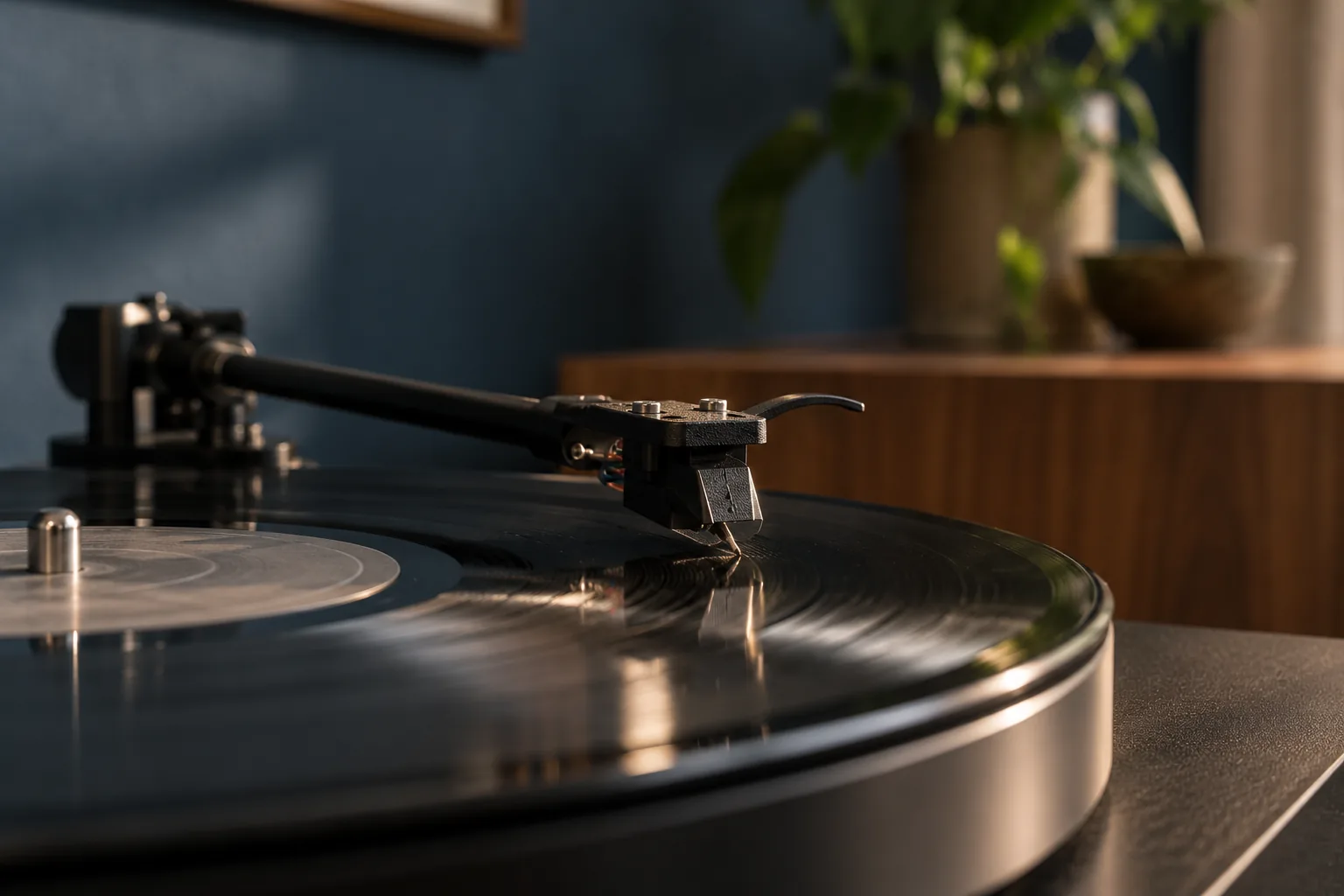
The problem: You are not sure whether your stylus needs replacing, and the only guide you have is a number of hours on the packaging that says nothing about how your records sound right now.
The short route: Trust what you hear and see, not an hour counter, and replace it as soon as the symptoms repeat across several records.
What actually wears
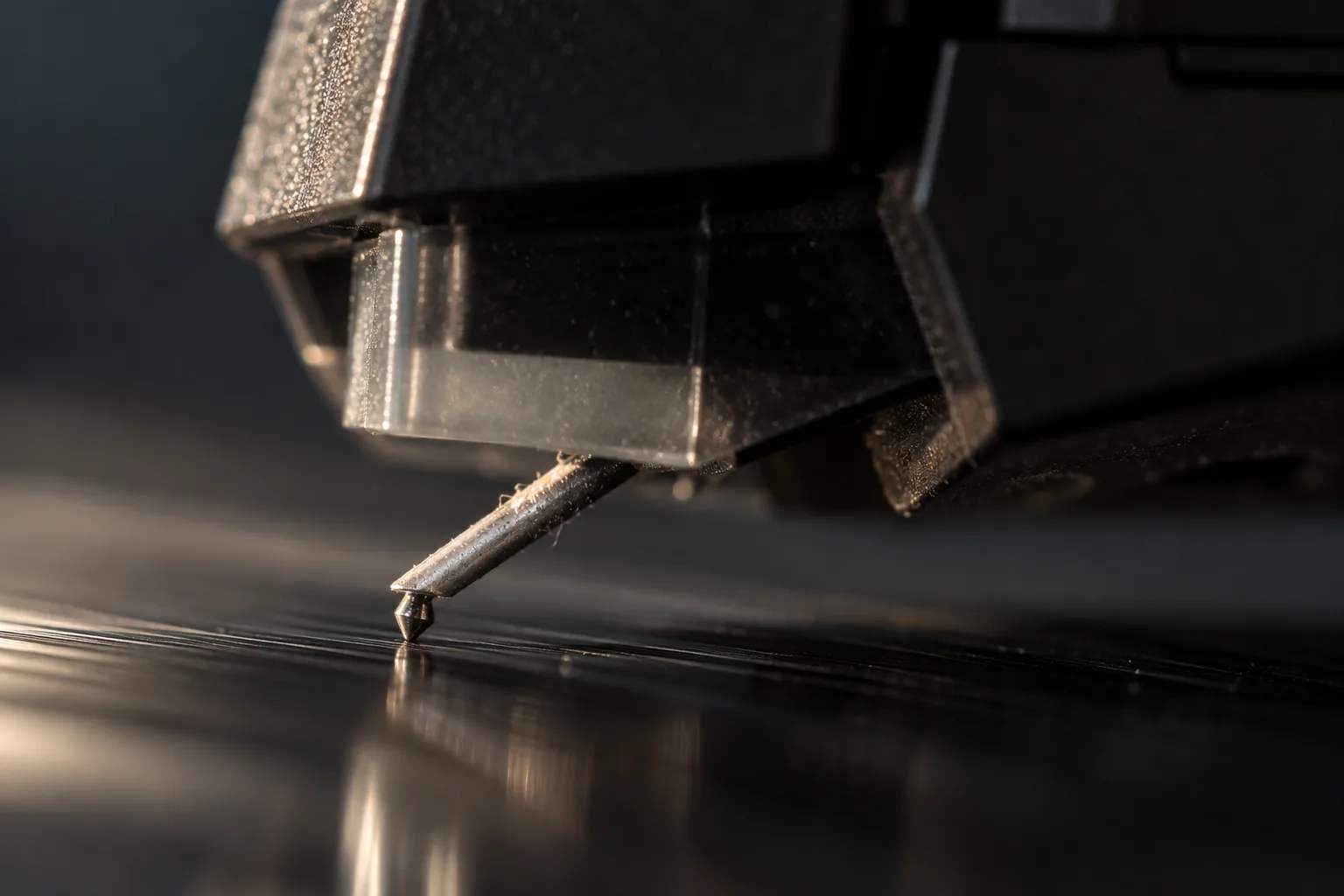
The stylus is a polished diamond of less than half a millimetre, glued to a thin tube called the cantilever, which in turn hangs in a small rubber block. That diamond runs through a groove at a force of about two grams, but because the contact area is microscopically small, the pressure on that area is enormous. Diamond does wear from that, just slowly.
Two things wear at the same time, and the second is almost always forgotten. The contact surfaces of the tip flatten, so the stylus no longer follows the finest movements in the groove. And the rubber the cantilever hangs in hardens over the years, even when the turntable is not used. A fifteen-year-old cartridge that has never been used therefore still sounds limp and lifeless.
That is also why this is about more than sound. A flattened tip no longer sits neatly against the groove wall but scrapes along it with an edge. What you hear is a little distortion; what happens is that every record you play afterwards wears beyond repair. A stylus costs a few tens of euros; a collection does not.
Why an estimate in hours says little
The hours a manufacturer gives, usually 500 to 1000, are an average calculated for a pattern of use that probably does not match yours. Someone who plays one side every evening on a clean record wears their stylus differently from someone who now and then puts on a dusty second-hand record. The number on the packaging is a safe minimum, not a prediction for your record cabinet.
Tracking force, the condition of your records and how often you clean have at least as much influence as the number of hours. Two turntables with the same counter can therefore be in very different condition. And the shape of the tip counts too: a simple round stylus touches the groove over a larger area and lasts longer than a finer elliptical one, which gets more detail out but wears faster at its contact edges.
If you still want a feel for your own number, keep a rough count. One side is about twenty minutes, so three sides an evening three evenings a week is roughly a hundred and fifty hours a year. Write the month you fitted the stylus on a slip of paper and keep it in the cabinet. That is not science, but it saves the feeling that you could be completely wrong.
What you can hear
When listening, pay attention to the end of a side, where the grooves are closer together and the stylus has to work hardest. A worn stylus loses grip there first, and you hear it as distortion in a loud or densely arranged passage, while the same track sounded fine earlier on the side.
Hissing s-sounds in vocals are the second sign, especially on songs where a voice is close to the microphone. The third is less well known and often says the most: the stereo image narrows and the voice in the middle seems to creep forward, as if the recording is folding in on itself. A channel that is quieter or drops out belongs to the same family of symptoms.
The test that makes the difference is simple. Put on three different records you know well, and listen to the same kind of passage: loud, busy, at the end of the side. If you hear it on all three, it is the stylus. If you hear it on one, it is that record.
What you can see
You cannot judge wear with the naked eye, and that is the first thing to know before you start looking. What you can see without help is dirt: a grey ball of fluff against the tip, or a tuft of dust on the cantilever. That is not wear but contamination, and a brush solves it.
For the tip itself you need magnification. A ten-times loupe is enough, and a phone's macro mode with a light beside it works surprisingly well. You are looking for three things: a tip that looks like a point and not like a flattened facet, a cantilever that hangs straight down and neatly in the middle, and no caked-on layer that stays after brushing.
A crooked or bent cantilever is the only sight that means stop playing straight away. It is not worn but damaged, usually by a knock or by the arm dropping, and it drags through the groove at an angle. Otherwise: if you are unsure about what you see, what you hear counts for more. Wear you can hear but not see is still wear.
Clean first, replace second
A dirty stylus sounds exactly like a worn one, and that is the most common reason people buy a new one too early. Brush the tip before every side with a small stylus brush, always from back to front, so in the direction the record travels. From front to back you push against the suspension, and that is exactly the rubber you do not want to damage.
If there is a stubborn layer on it, use a cleaning gel and lower the tip into it gently a few times. Stay away from alcohol and from cleaning products: they dissolve the glue that holds the diamond on the cantilever. And never touch the tip with your fingers; it bends more easily than you think.
If the dirt keeps coming back, the problem is not the stylus but your records, and that dirt wears the tip as well. How to tackle that without making it a ritual is covered in the guide on cleaning records.
Stylus or cartridge: what exactly are you replacing
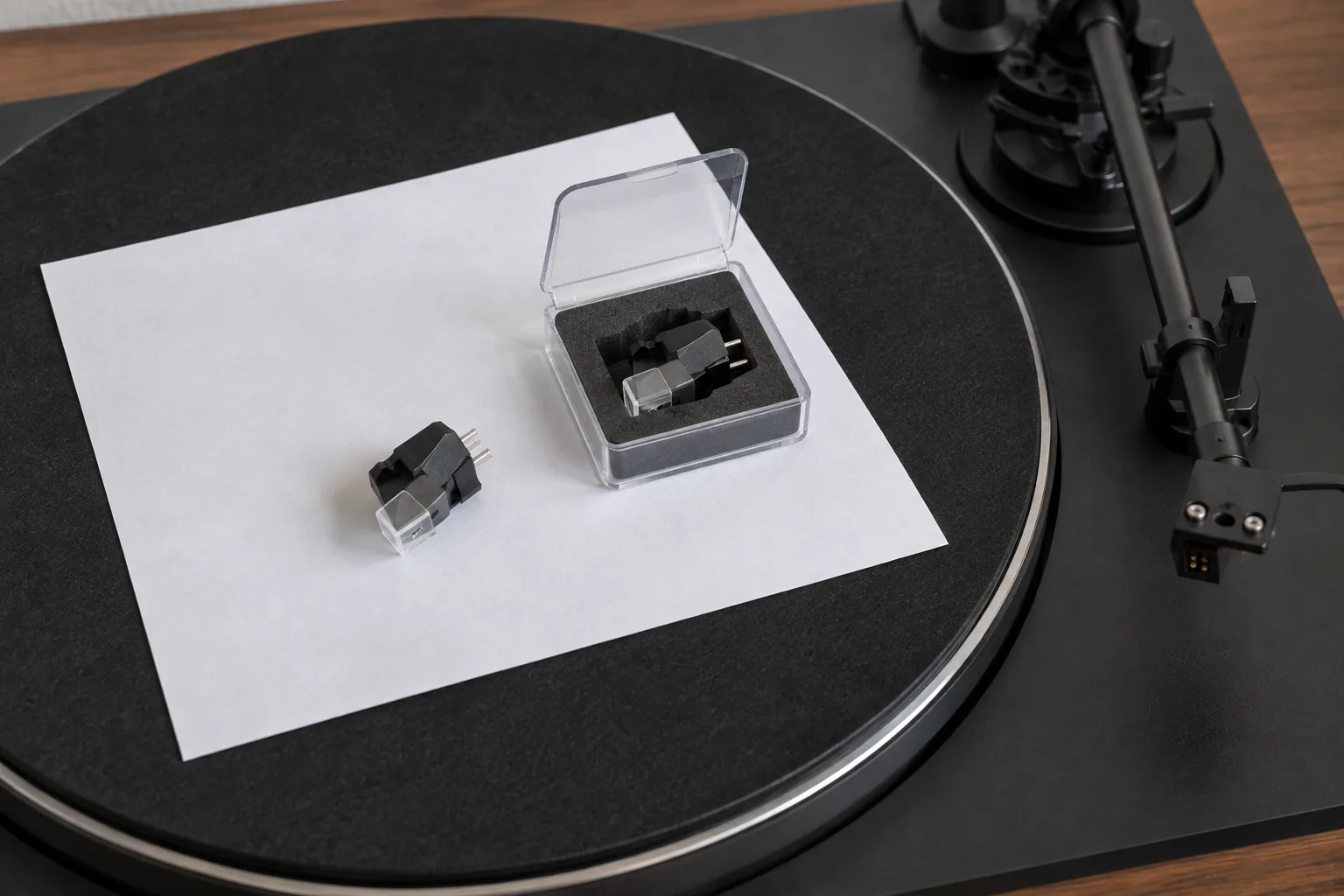
There are two kinds of cartridge and the difference decides the whole job. On the type fitted to almost every affordable turntable, the MM cartridge, the stylus is a separate cap that you pull straight off and slide a new one onto. So you only replace the stylus, the cartridge stays where it is, and nothing needs adjusting again.
On the other type, the MC cartridge, the stylus is fixed to the cartridge. When it wears out, the whole cartridge comes off and the new one has to be aligned and set up again. There are also companies that retip such a cartridge, which on the more expensive models is often cheaper than a replacement.
If you do not know which you have: gently try whether the front cap comes away forwards. If it gives, it is an MM and you are done in two minutes. If it is stuck fast, do not force anything and look up the model name first. It is usually on the side of the cartridge or in the turntable's manual, and you need it anyway to order the right replacement: styli are not interchangeable between brands and often not even between models from the same brand.
Changing it yourself, step by step
Switch the turntable off and pull out the plug, so you do not start the motor by accident while your hands are over the platter. Lock the arm in its rest. Lay a sheet of white paper on the platter: it gives light and catches the cap if it slips out of your fingers.
Hold the stylus cap by the sides, never by the tip, and pull it straight forwards and slightly down off the cartridge. It sits on a clip fitting and should come away with a light click. Twisting or wiggling breaks the cantilever, and then you need a new cartridge straight away.
Slide the new one on with the same movement until it clicks, and check from the side that it sits straight. Only take off the protective guard once it is in place. Keep the old stylus: if the problem is unchanged after the swap, it was not the stylus, and it is handy to be able to compare.
After the swap, check the tracking force. A new stylus of the same type needs the same force, so usually everything is still right, but this is the moment to check. Levelling, setting the tracking force and anti-skating are a subject in themselves and will get a guide of their own; for now what counts is that the arm hangs level and the turntable does not wobble.
What wears a stylus out faster
Dirt is the biggest culprit. Dust in the groove acts like sandpaper on a diamond that runs through it under high pressure, and second-hand records that go onto the turntable unwashed cost your stylus years. Brushing a side before you play it takes ten seconds and saves more than any expensive accessory.
Too little tracking force is the second, and that surprises most people. Setting the force low to spare the record actually makes the stylus bounce in the groove and scrape both sides of the groove wall. Too light is more harmful than slightly too heavy. Use the figure the cartridge maker gives, not the lowest one that still works.
The rest is housekeeping. Do not leave the arm in the run-out groove for hours, close the dust cover when the turntable is not in use, keep the turntable out of full sun and off furniture that vibrates with the speakers. And put the guard on the stylus if you will not use it for a while.
What it costs
A replacement stylus for a common MM cartridge costs between twenty-five and sixty euros. For a finer elliptical or a better tip profile you pay between sixty and a hundred and fifty, and that is also the cheapest way to make an entry-level turntable audibly better: the same cartridge with a better tip.
A complete new cartridge starts at around eighty euros and runs to a few hundred for the better MM models. Having an MC cartridge retipped usually costs between a hundred and fifty and three hundred, which only pays off for cartridges that are worth more themselves.
Set that against what the alternative costs. Playing on a worn stylus damages every record you put on afterwards, and that damage does not come out. A hundred records are soon worth more than the whole turntable. If you are torn between carrying on for another six months or replacing it now, that is the reason to replace it. Which turntable belongs under that cartridge is covered in the guide on choosing a turntable.
Frequently asked questions
- Does a worn stylus damage your records?
- Yes, and that is the real reason to replace it in time. A flattened tip no longer sits neatly against the groove wall but scrapes along it with an edge, and that wear in the groove never comes out. A stylus costs a few tens of euros; the records you play with it afterwards cost more.
- How long does a turntable stylus last?
- Manufacturers often say 500 to 1000 playing hours, but that is an average. Play clean records with the right tracking force and you get more; play dusty second-hand records and you get less. Replace on what you hear and see, not on the counter. A cartridge that sits unused for years also hardens in its suspension, even without playing hours.
- Can you replace a stylus yourself?
- On an MM cartridge, yes: you pull the stylus cap by its sides straight forwards off the cartridge and slide the new one on until it clicks. Do not touch the tip and do not twist. If the stylus is fixed to the cartridge, it is an MC and the whole cartridge has to come off, with realignment and setting the tracking force again.
- My record clicks: is it the stylus?
- Usually not. Clicks almost always come from dust or dirt in the groove, or from a scratch. Clean the record and the stylus first. If it still clicks on several clean records at the same point in the side, only then look at the stylus.
- My record skips: what is the cause?
- Skipping has three usual causes: too little tracking force, a turntable that is not level or stands on vibrating furniture, or a scratch in the record. Check the tracking force against your cartridge's specification, put the turntable on a solid, level surface and try the same record again.