
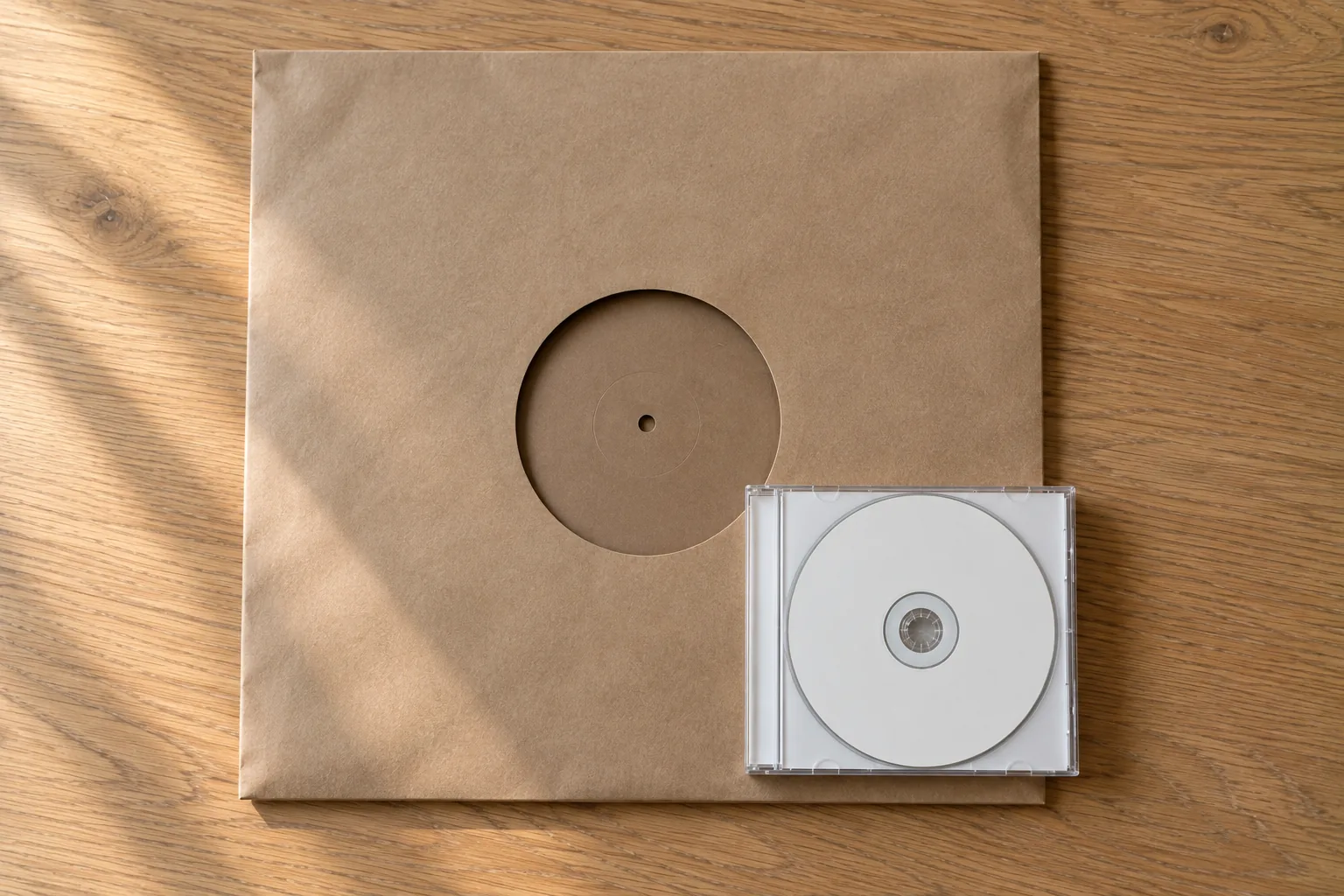
The problem: You want to start buying music on physical formats, but you are not sure which one suits you.
The short route: Choose per album, not per collection: vinyl for the albums you make time for, CD for everything you want to grab without fuss.
The difference is in what you do with it
LP or CD is less a question about sound than about what you do with it. One side of an LP lasts eighteen to twenty-two minutes. Then you have to get up. That one fact explains most of the difference between the two formats, because it means a record calls you back to the room it is in roughly every half hour.
Vinyl also asks for a few actions each time: take out the sleeve, slide out the record, brush off the dust, lower the stylus. For many people that is exactly the appeal. It turns listening into something you do rather than something that is on, and you do not skip to something else halfway through.
A CD does the opposite. It starts straight away, plays for up to eighty minutes and asks nothing of you in between. In the car, while cooking, for long sessions and for music you want to hear from start to finish without a break, that is not a compromise but exactly the right quality.
LP vs CD: does vinyl sound better? The honest answer
On paper, no. A CD has more dynamic range than a record, no surface noise, no clicks and no distortion that builds towards the end of the side, and the last minute sounds exactly as good as the first. On a record the grooves get closer together towards the end and the stylus has a harder job, and you can hear it.
And yet in practice a record often does sound better, for a reason that has nothing to do with the format. From the nineties onwards CD releases were mastered louder and louder, squeezing out the difference between quiet and loud so they would stand out on the radio and in the shop. A record physically cannot take that treatment, so vinyl is often cut from a different, gentler master. What you hear then is not the vinyl but a better version of the same recording.
That gives a practical rule: compare releases, not formats. A careful CD release from 1987 beats a rushed 180-gram reissue, and the other way round just as easily. What the sleeve says about weight or colour tells you nothing here; that is explained in the guide on giving vinyl as a gift, where the same terms come up.
What it costs
A new LP usually costs 25 to 35 euros, and a new CD of the same album 10 to 20. Second-hand the gap widens: at markets and charity shops CDs go for a few euros, while sought-after records have become more expensive. For the same money you buy three to ten times as much music on CD.
The equipment counts too. A usable turntable with a decent cartridge, a phono preamp and speakers is an investment of a few hundred euros before anything plays. A CD player costs a few tens of euros second-hand, and many people already have something at home that plays CDs.
That makes the difference bigger than a single purchase suggests. Buy one album a month and you spend well over three hundred euros a year on vinyl and between one and two hundred on CD, with the same music on the shelf.
Space, weight and moving house
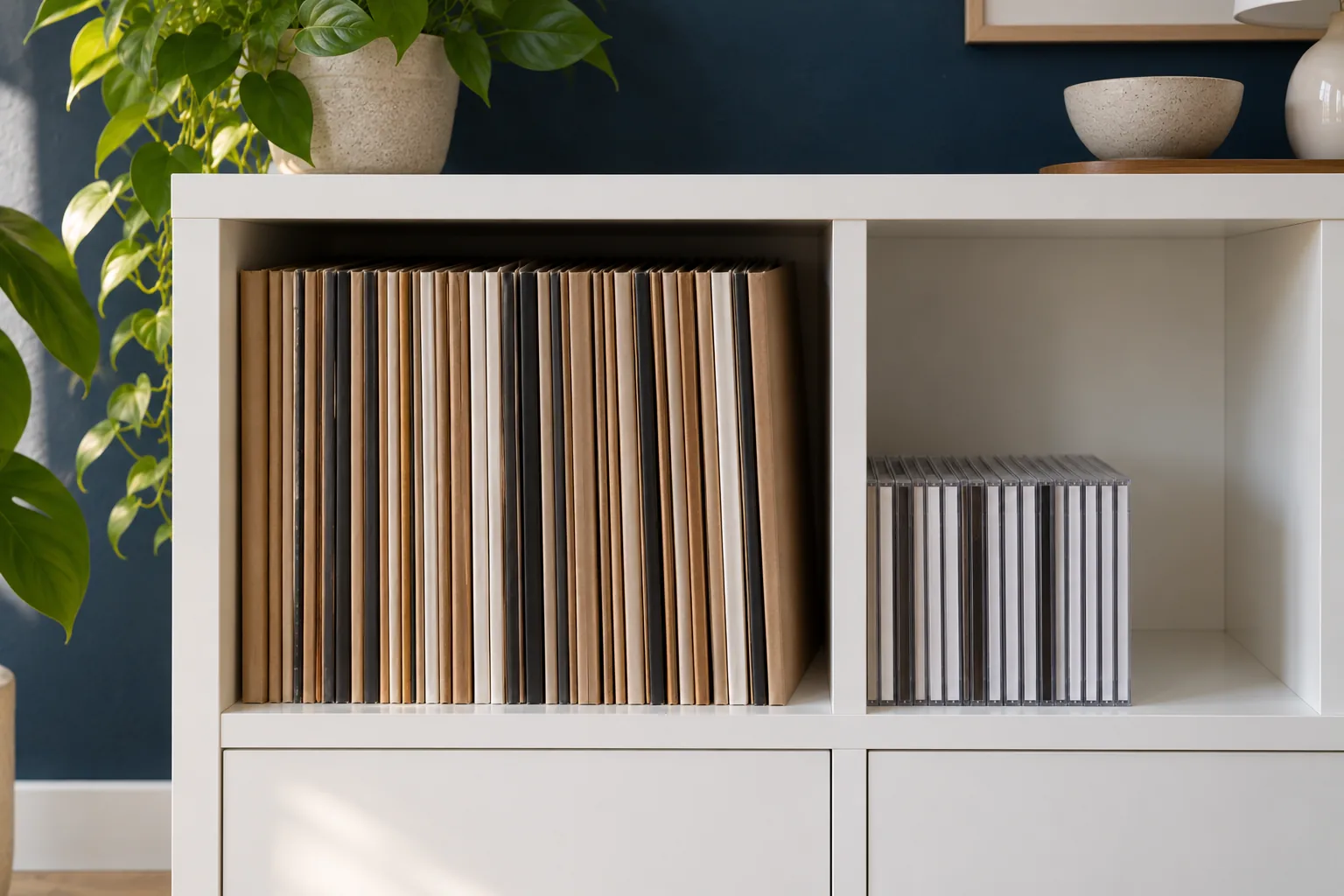
A hundred records take up about a metre of shelf, 33 centimetres deep, and weigh over twenty kilos. A hundred CDs in jewel cases also take about a metre of shelf, but only 15 centimetres deep and a few kilos. That difference in depth is why records need a cabinet of their own while CDs fit in almost any bookcase; which cabinet can take records is covered in the guide on buying a record cabinet.
The weight only really shows when you move. A thousand records are over two hundred kilos in boxes you cannot lift alone, and they have to stay upright or they arrive warped. A thousand CDs fit in a handful of boxes you can carry with one hand.
In a small home that is not a detail but the whole decision. A collection that fits keeps growing; a collection that does not fit moves to the attic and stops being played.
What happens to them in the long run
A record wears a little each time it is played, and how fast depends on the stylus and on how clean the groove is. A worn stylus scrapes the groove wall and that damage is permanent, which is the main reason to replace it in time; when that is, is covered in the guide on replacing the stylus. Treated well, a record lasts for decades, and a record from 1970 still plays today.
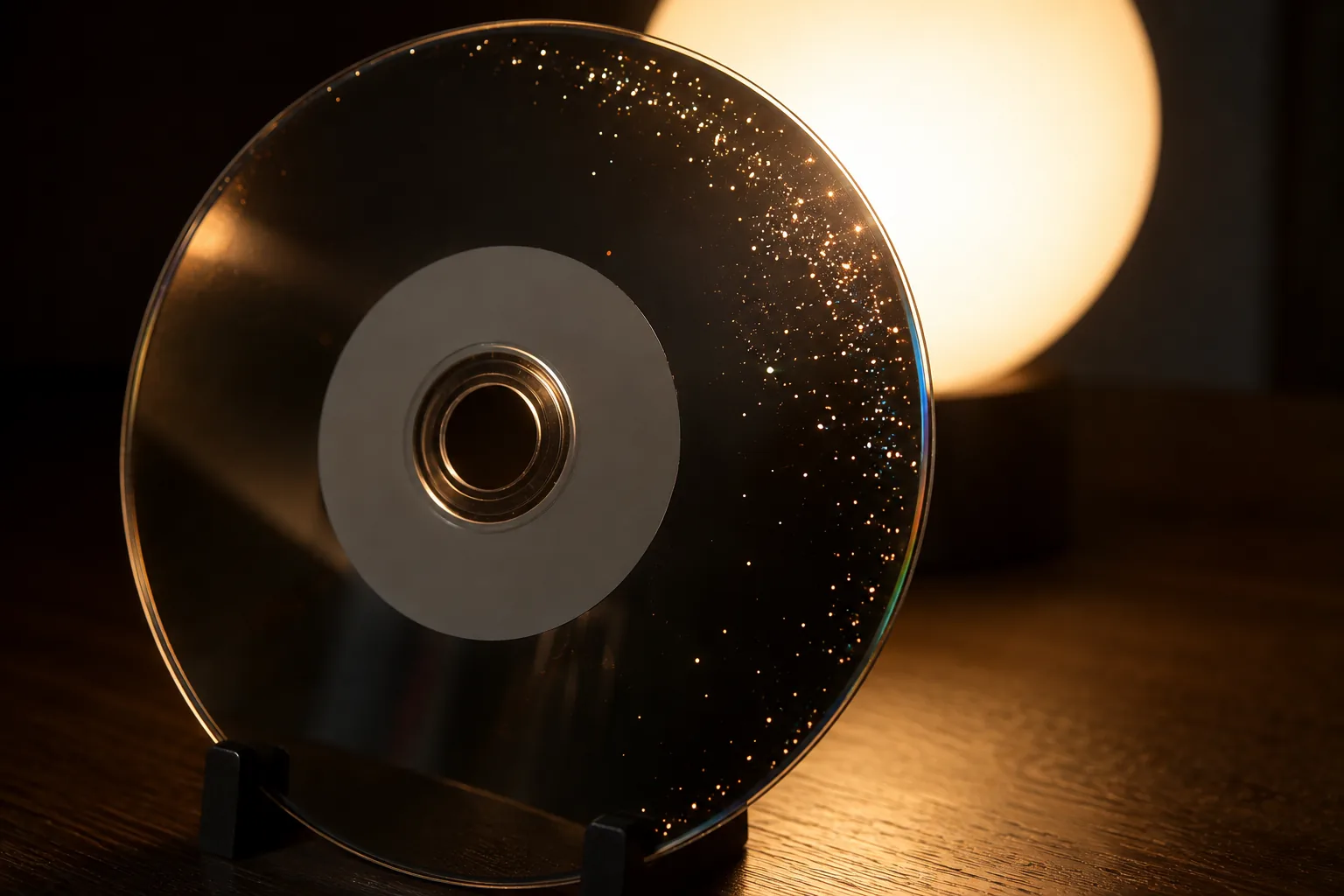
A CD does not wear from playing: nothing touches the surface. What can happen is a crack by the hole in the middle from prising it out of the case too hard, and on some pressings from the eighties a breakdown of the reflective layer. You can spot that by tiny pinpricks of light when you hold the disc up to a lamp.
On balance there is not much between them: both formats outlast the equipment that plays them, as long as you keep them out of the sun and away from heat.
Choose per album, not per collection
The most useful question is not which format is better, but what you want to do with this one album. An album you want to take in from start to finish, and that you sit down for, is a record. Catalogue music, anything you play in the background and anything you want to reach for often, is a CD.
There are two kinds of music where the format itself settles it. Classical and long electronic pieces get cut in half by the side change on vinyl, and a symphony that has to be turned over in the middle of a movement loses more than it gains on any format. Box sets and complete catalogues are the second: on CD a collected edition costs a fraction and fits in twenty centimetres of shelf.
If you are unsure about a title, think about what you want it for. A listening evening, a trip, a gift. That answer usually gets you further than a forum argument about which format is supposedly better.
A mixed collection works fine
Your collection does not have to be consistent, and most collections that are still growing are not. New releases on CD and favourites on vinyl is a workable rule. Keeping only records you want to play from start to finish is another.
Once you have a rule like that for yourself, you buy less on impulse and listen more often to what you already own. That is the real benefit: not that the rule is right, but that it takes the decision off your hands in the shop.
Keep the two formats physically apart, if only because they need different depths. How to organise the records within that without it becoming a chore is covered in the guide on organising your record collection.
If you are starting now
Start with CDs if you mainly want the music. For a hundred euros you build a base that lasts you months, you find out which albums you actually go back to, and you do not need a system that has to be set up first.
Start with vinyl if you mainly want the listening: the ritual, the format, the evening built around one side. But budget for the equipment, the space and the care that come with it, because a record without a decent turntable is the most expensive way to listen badly.
And if you do not know: buy the next album you want on CD, and the album you are most looking forward to on vinyl. After ten purchases you will know which pile you reach for more often, and that is a better answer than any guide can give.
Frequently asked questions
- Does vinyl sound better than CD?
- Not technically: a CD has more dynamic range, no surface noise and no distortion that builds towards the end of the side. In practice a record often sounds better anyway, because vinyl is usually cut from a gentler master while CD releases since the nineties have often been mastered loud. What you hear then is the master, not the format.
- What is the difference between an LP and a CD?
- An LP is a 30-centimetre (12-inch) vinyl record with sides of eighteen to twenty-two minutes, which you turn over halfway. A CD is 12 centimetres across and plays for up to eighty minutes without a break. A new LP usually costs 25 to 35 euros, a new CD 10 to 20. A hundred LPs take a metre of shelf 33 centimetres deep, a hundred CDs a metre 15 centimetres deep.
- Which is cheaper, vinyl or CD?
- CD, by a wide margin. A new LP costs 25 to 35 euros and the same title on CD 10 to 20, and second-hand CDs go for a few euros while sought-after records are getting more expensive. On top of that, a turntable with a cartridge, a preamp and speakers costs a few hundred euros before anything plays.
- How much space do a hundred records and a hundred CDs take?
- Both about a metre of shelf, but records need 33 centimetres of depth and weigh over twenty kilos, while CDs in jewel cases are 15 centimetres deep and weigh a few kilos. That is why CDs fit in almost any bookcase and records need a cabinet made for them.
- Does a record wear out from playing?
- Yes, a little each time, and how fast depends on the stylus and on how clean the groove is. A worn stylus or dust in the groove damages the groove wall permanently. A CD does not wear from playing, because nothing touches the surface; it can crack by the centre hole, though, or on some old pressings develop a damaged reflective layer.