
The problem: CDs are less visible than vinyl, but you are looking for a smart way to collect music on a physical format.
The short route: Use CD for catalogue music, long listening sessions and affordable discoveries, and buy second-hand on the condition of the disc.
Why the CD is back
The CD has not come back because it got prettier, but because it is cheap. When everyone emptied their shelves for streaming at the same time, the second-hand market collapsed, and it never recovered. The same album that costs thirty euros on vinyl is two euros at a market.
On top of that, the CD never really went away at the labels. Most albums still come out on CD, often cheaper than on vinyl and sometimes with material the LP version lacks: extra tracks that did not fit on two sides, and booklets with lyrics and credits that simply suit a CD format better than a single insert.
For anyone who wants to own music physically without making a project of it, that is a strong combination. You build your own base quickly, you find out which albums you actually go back to, and you do not need a system that has to be set up first. How that compares with vinyl is covered in the guide on vinyl or CD.
What a tenner buys you
At a market or in a charity shop, two to four euros per CD is normal, and that is for ordinary, complete copies of albums you know. For the price of one new LP you buy about ten CDs, and that changes how you buy: you no longer have to be sure you like something before you take it home.
Collected editions are the second reason. A box with an artist's complete studio albums often costs less on CD than two single LPs and fits in twenty centimetres of shelf. If you want to really get to know an artist rather than own one album, it is the cheapest route there is.
The trap is the same as with any cheap purchase: you buy too much and listen too little. A simple brake helps, for example taking home no more than you can listen to in a month. How to do that without taking the fun out of it is covered in the guide on building a record collection on a small budget.
Buying second-hand: what to look for
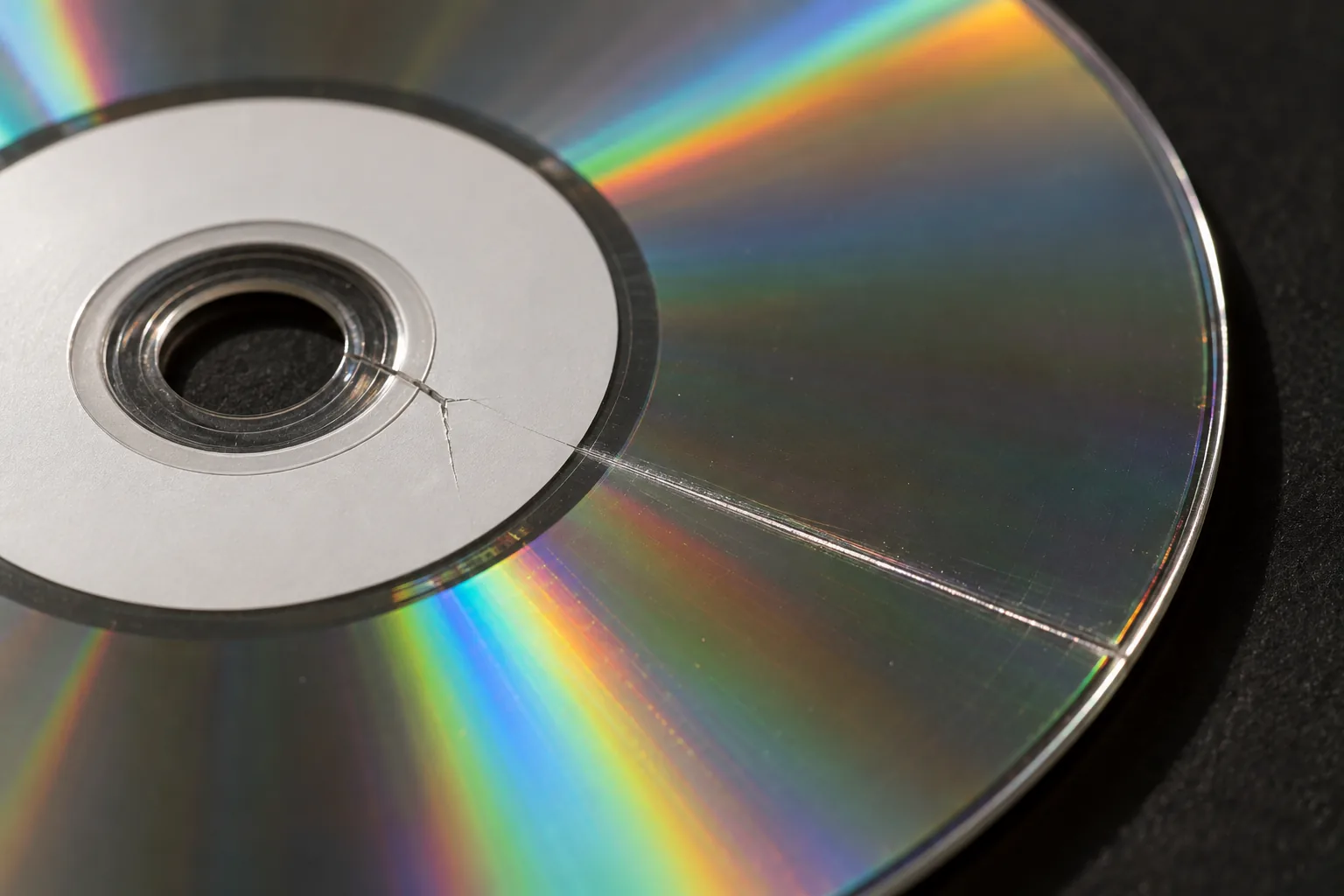
Hold the disc by the edge and the centre hole and tilt it under a lamp. Scratches that run with the track, so in a circle, are rarely a problem, because error correction catches them. Scratches that run from the centre to the edge are, because they hit a continuous stretch of data; one deep radial scratch can make a track skip.
Then look at the hole in the middle. Small hairline cracks around the hub come from prising the disc out of a jewel case too hard, and they spread; a disc that is cracked there only gets worse. This is the damage people miss because they are looking at the playing surface.
Finally, hold the disc up to the light and look for pinpricks. On some pressings from the eighties the air attacks the reflective layer, usually from the edge, and then you see tiny points of light coming through the disc. That disc cannot be saved. A dirty or scribbled-on case, on the other hand, is no objection: an empty jewel case costs a few cents, and the booklet simply moves across.
Cleaning works exactly the other way round from records
With a record you wipe along the groove, in a circle. With a CD you do exactly the opposite: from the centre straight out to the edge, in short straight strokes. The reason is error correction. A straight wipe causes at most short interruptions spread across many tracks, which the player repairs; a circular wipe follows one track and can make a stretch of data unreadable in one go.
Use a soft, dry microfibre cloth, and for grease or fingerprints a cloth with a little lukewarm water. Stay away from alcohol, glass cleaner and anything with solvents: the reading side is a thin layer of polycarbonate, and the printed side is more fragile than the reading side, because the reflective layer sits just under the label.
Always hold a disc by the edge and the centre hole, never with your fingers on the playing surface. That sounds fussy and is not: grease attracts dust, and dust becomes a scratch when you put the disc back in its case.
Storing them without losing a wall
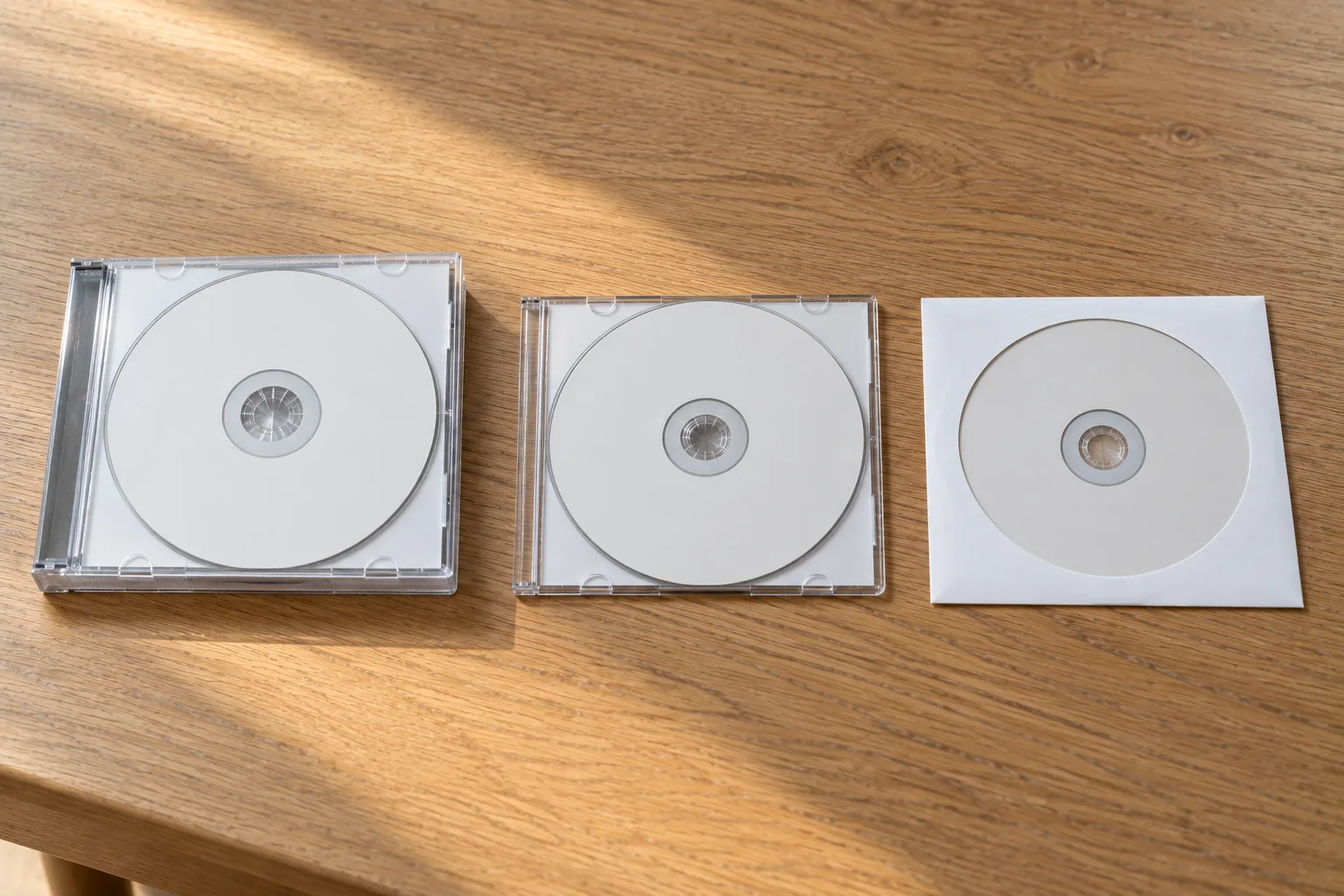
A jewel case is ten millimetres thick, so a hundred CDs take about a metre of shelf at a depth of fifteen centimetres. That fits in almost any bookcase, which is straight away the biggest practical advantage of the format.
Slimline cases are five millimetres and halve that, but they protect less and the booklet often does not fit well. Paper or plastic sleeves in a binder cut the space down further and are popular for big collections, with two real drawbacks: booklets get separated from their disc, and discs that slide into a sleeve pick up fine scratches over time.
Whatever you choose, keep the booklet with the right disc. That is the part of a CD that cannot be replaced; the case can. Also keep them upright and out of the sun, and do not leave a disc loose in a car door or on a desk, because that is where almost all scratches come from.
A digital copy for when you are out
A CD has one quality no subscription gives you: you can make a copy of it yourself for your own use. In the Netherlands that falls under the private copying rules, and in practice it means you rip the disc once and then have both the original on the shelf and a file on your phone.
You need very little for it. An external CD drive for a computer costs a few tens of euros, and most programs that do this fetch titles and credits automatically. Preferably rip without loss of quality, in a format such as FLAC or ALAC, because then your copy is identical to the disc and you can always make something smaller from it later.
That is also the answer to the complaint that physical music is inconvenient. The disc stays at home on the shelf and does not break, and the music comes with you. You buy it once and keep it, even if it disappears from a catalogue next year.
What to play them on
Many people already have something at home that plays CDs: an old hi-fi tower, a DVD or Blu-ray player under the TV, or a laptop with an external drive. Start with that. You do not need to buy anything to find out whether this format suits you.
If you do want to buy something for it, the second-hand market is as kind here as it is for the discs themselves. Standalone CD players from the nineties and two-thousands are solidly built and cost from a few tens of euros to a few hundred. Check the tray: it is the part that falters first, and a tray that does not open smoothly is worth a repair or a reason to walk on.
Whether a separate player is better in your situation than a streamer with the same music on it is a question of its own, with more nuance than fits here. It will get a guide of its own.
Give them a place where you can see them
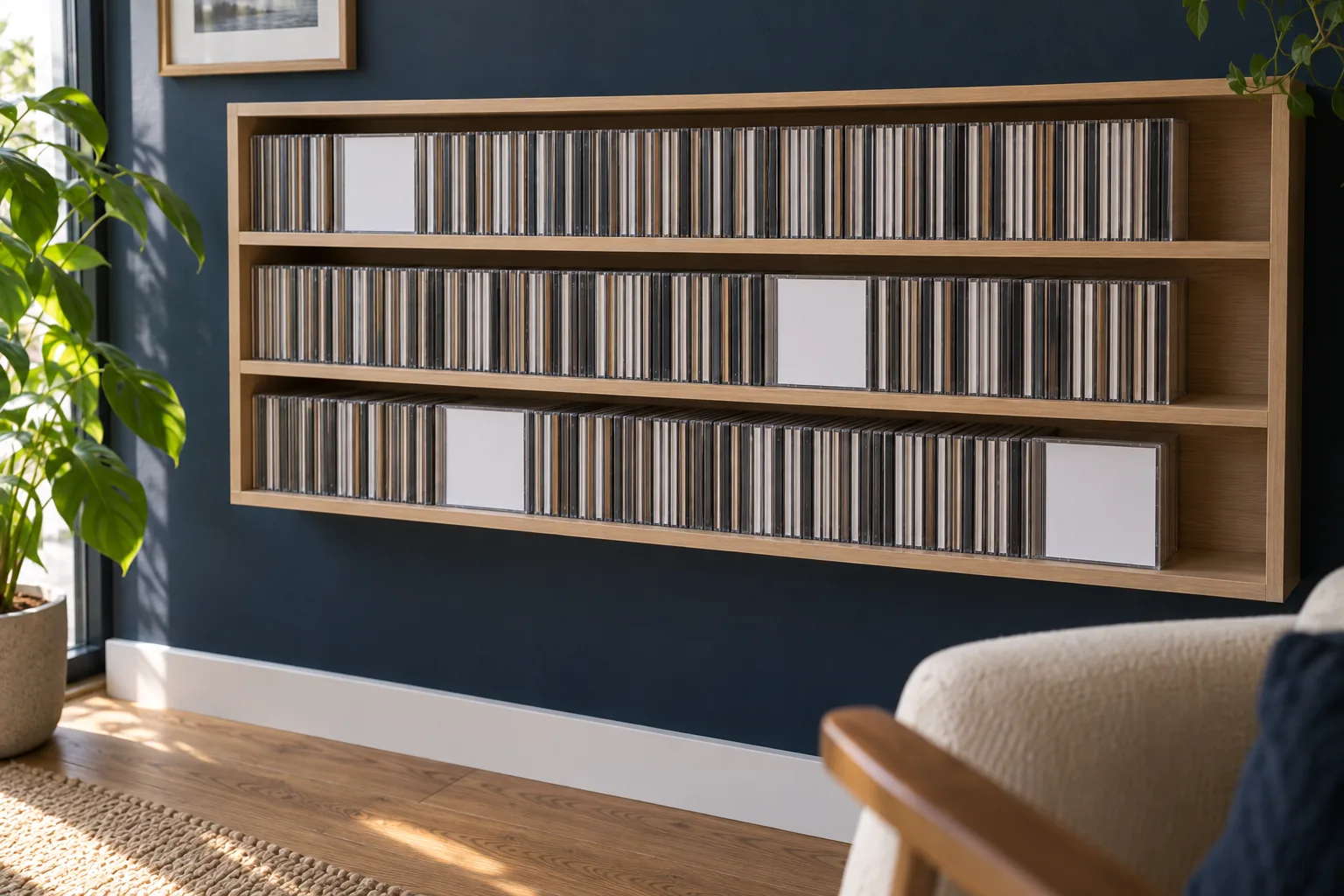
The biggest risk to a CD collection is not that it breaks, but that it disappears from view. A box in the attic is the end of a collection, because what you cannot see you do not play. A compact unit in the room, with the spines visible, does more for your listening than any purchase.
You do not have to pretend it is an LP. The scale is exactly the advantage: you can have hundreds of albums at home on half a bookcase, and see an artist's whole catalogue side by side. Put a few favourites face out among them, as in a shop, so the shelf is not just a row of spines.
And organise them. The same principle as with records: the simplest system you can keep up, with the edge cases decided once. That is worked out in the guide on organising your collection, and it works exactly the same for discs.
Frequently asked questions
- What are the dimensions of a CD?
- A CD is 12 centimetres across and 1.2 millimetres thick, with a 15-millimetre hole in the middle. A standard jewel case measures 142 by 125 millimetres and is 10 millimetres thick; a slimline case, at 5 millimetres, is half that.
- How much space do a hundred CDs take?
- In jewel cases about a metre of shelf, because each case is 10 millimetres thick. In slimline cases, half that. For a cabinet, allow a depth of at least 15 centimetres so the cases do not stick out.
- How do you spot a damaged second-hand CD?
- Tilt the disc under a lamp. Circular marks that follow the track are usually caught by error correction; scratches running from the centre to the edge are not, because they hit a continuous stretch of data. Also look for hairline cracks around the centre hole, and hold the disc up to the light: pinpricks mean a damaged reflective layer, and that cannot be saved.
- How do you clean a CD?
- With a soft dry microfibre cloth, from the centre straight out to the edge in short strokes, never in circles. A circular wipe follows a track and can make a whole stretch of data unreadable, while a straight wipe only causes short interruptions that the player repairs. Do not use alcohol or solvents, and hold the disc by the edge and the centre hole.
- Do new albums still come out on CD?
- Yes. Most albums still come out on CD, often cheaper than on vinyl and sometimes with extra material the LP version lacks. Online the range is bigger than what you see on the shop floor.